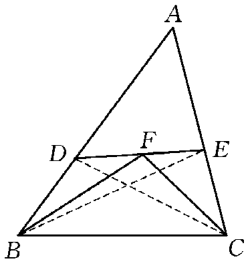
Let △ABC be a triangle. Points D and E are on sides AB and AC, respectively, and point F is on line segment DE. Let ABAD=x, ACAE=y, DEDF=z. Prove that
(1) S△BDF=(1−x)yzS△ABC and S△CEF=x(1−y)(1−z)S△ABC;
(2) 3S△BDF+3S△CEF≤3S△ABC.
(posed by Li Weigu)
Solution
Connect BE and CD. Then we have
(1) S△BDF=zS△BDE=z(1−x)S△ABE =z(1−x)yS△ABC and S△CEF=(1−z)S△CDE =(1−z)(1−y)S△ACD =(1−z)(1−y)xS△ABC.
(2) From (1) we get 3S△BDF+3S△CEF=(3(1−x)yz+3x(1−z)(1−y))3S△ABC≤(3(1−x)+y+z+3x+(1−y)+(1−z))3S△ABC=3S△ABC.
Want a route through all this instead of an archive? The track
puts 2,604 problems in a working order, from Junior Challenge level to the IMO shortlist.
Source: MathNet,
licensed CC-BY-4.0.
Statement reproduced verbatim; metadata (topic, difficulty) added by this project.