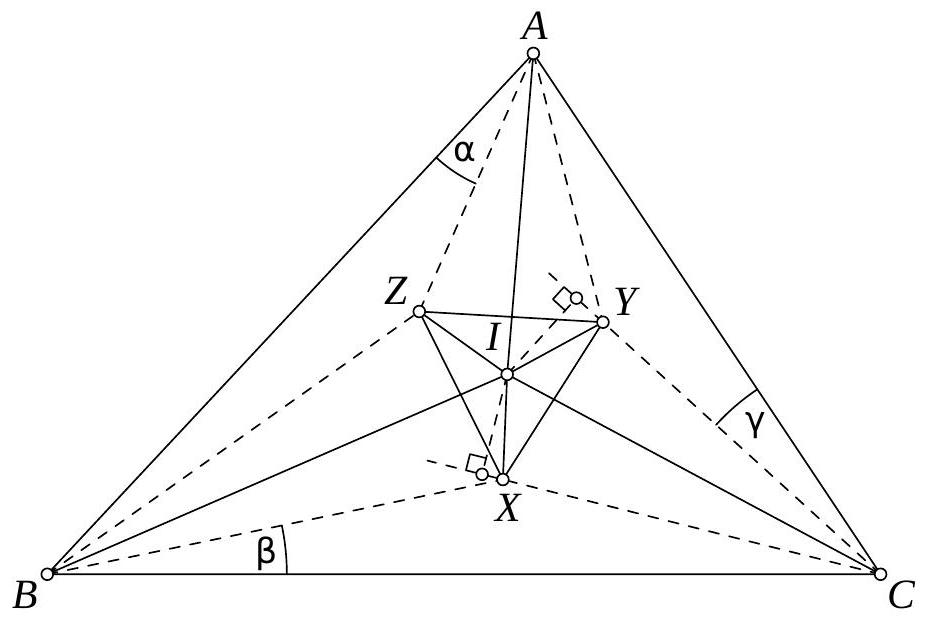
Let ABC be a triangle with incenter I and let X, Y and Z be the incenters of the triangles BIC, CIA and AIB, respectively. Let the triangle XYZ be equilateral. Prove that ABC is equilateral too.
Solution
AZ, AI and AY divide ∠BAC into four equal angles; denote them by α. In the same way we have four equal angles β at B and four equal angles γ at C. Obviously α+β+γ=4180∘=45∘; and 0∘<α,β,γ<45∘.
Easy calculations in various triangles yield ∠BIC=180∘−2β−2γ=180∘−(90∘−2α)=90∘+2α, hence (for X is the incenter of triangle BCI, so IX bisects ∠BIC) we have ∠XIC=∠BIX=21∠BIC=45∘+α and with similar arguments ∠CIY=∠YIA=45∘+β and ∠AIZ=∠ZIB=45∘+γ.
Furthermore, we have ∠XIY=∠XIC+∠CIY=(45∘+α)+(45∘+β)=135∘−γ, ∠YIZ=135∘−α, and ∠ZIX=135∘−β.
Now we calculate the lengths of IX, IY and IZ in terms of α, β and γ. The perpendicular from I on CX has length IX⋅sin∠CXI=IX⋅sin(90∘+β)=IX⋅cosβ. But CI bisects ∠YCX, so the perpendicular from I on CY has the same length, and we conclude IX⋅cosβ=IY⋅cosα To make calculations easier we choose a length unit that makes IX=cosα. Then IY=cosβ and with similar arguments IZ=cosγ.
Since XYZ is equilateral we have ZX=ZY. The law of cosines in triangles XYI, YZI yields ⟹⟹⟹ZX2=ZY2IZ2+IX2−2⋅IZ⋅IX⋅cos∠ZIX=IZ2+IY2−2⋅IZ⋅IY⋅cos∠YIZIX2−IY2=2⋅IZ⋅(IX⋅cos∠ZIX−IY⋅cos∠YIZ)L.H.S.cos2α−cos2β=R.H.S.2⋅cosγ⋅(cosα⋅cos(135∘−β)−cosβ⋅cos(135∘−α)). A transformation of the left-hand side (L.H.S.) yields L.H.S.=cos2α⋅(sin2β+cos2β)−cos2β⋅(sin2α+cos2α)=cos2α⋅sin2β−cos2β⋅sin2α =(cosα⋅sinβ+cosβ⋅sinα)⋅(cosα⋅sinβ−cosβ⋅sinα)=sin(β+α)⋅sin(β−α)=sin(45∘−γ)⋅sin(β−α) whereas a transformation of the right-hand side (R.H.S.) leads to R.H.S.=2⋅cosγ⋅(cosα⋅(−cos(45∘+β))−cosβ⋅(−cos(45∘+α)))=2⋅22⋅cosγ⋅(cosα⋅(sinβ−cosβ)+cosβ⋅(cosα−sinα))=2⋅cosγ⋅(cosα⋅sinβ−cosβ⋅sinα)=2⋅cosγ⋅sin(β−α) Equating L.H.S. and R.H.S. we obtain ⟹⟹sin(45∘−γ)⋅sin(β−α)=2⋅cosγ⋅sin(β−α)sin(β−α)⋅(2⋅cosγ−sin(45∘−γ))=0α=β or 2⋅cosγ=sin(45∘−γ). But γ<45∘; so 2⋅cosγ>cosγ>cos45∘=sin45∘>sin(45∘−γ). This leaves α=β.
With similar reasoning we have α=γ, which means triangle ABC must be equilateral.
Want a route through all this instead of an archive? The track
puts 2,604 problems in a working order, from Junior Challenge level to the IMO shortlist.
Source: MathNet,
licensed CC-BY-4.0.
Statement reproduced verbatim; metadata (topic, difficulty) added by this project.