Let be a trapezoid with parallel sides . Points and lie on the line segments and , respectively, so that . Suppose that there are points and on the line segment satisfying
Prove that the points , , and are concyclic.
IMO Shortlist, 2006
Solutions — 2
Solution 1
Because , the relation readily implies that the lines , and have a common point .
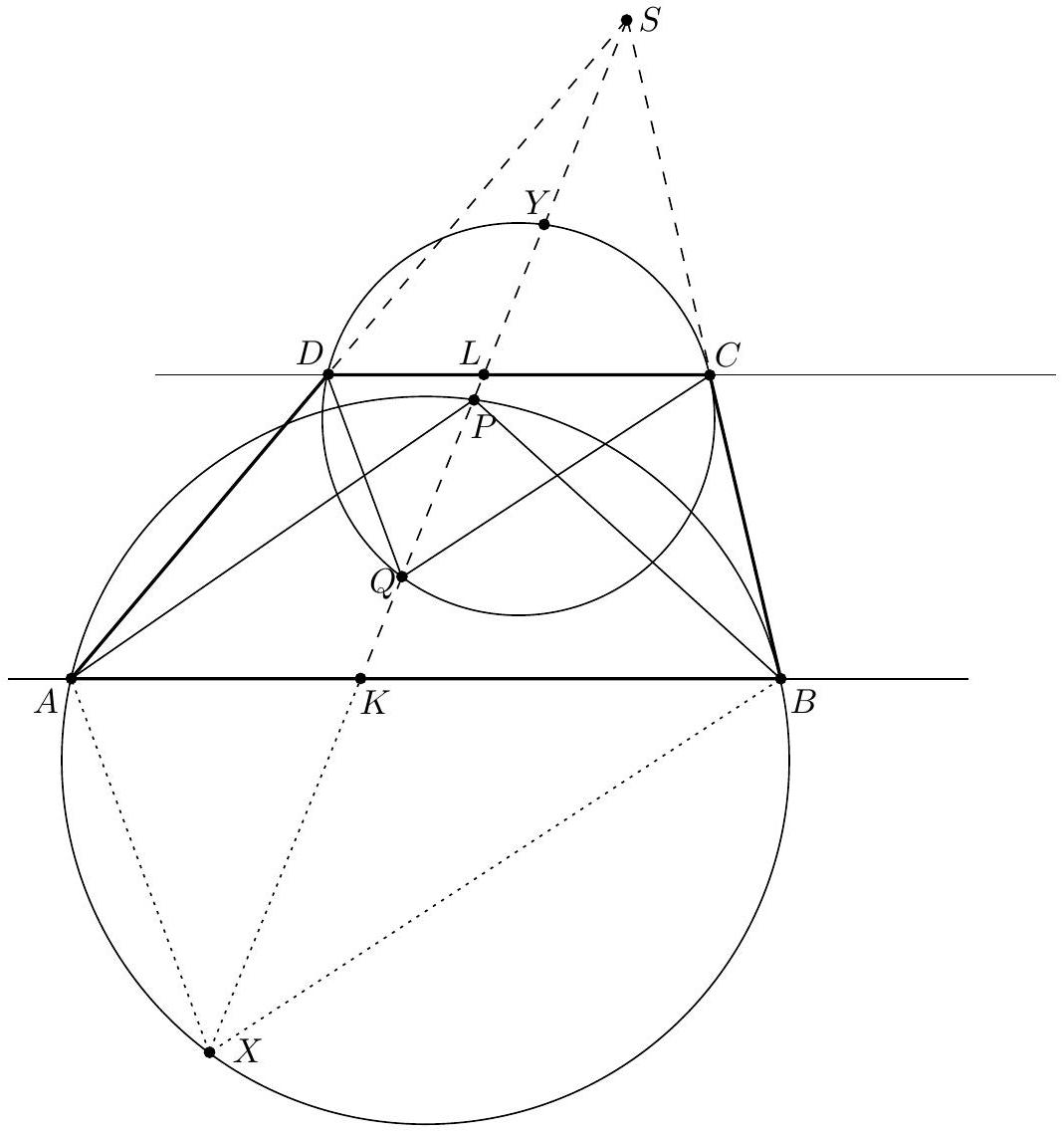
Consider the second intersection points and of the line with the circles and , respectively. Since is a cyclic quadrilateral and , one has
This shows that is tangent to the circle at . Likewise, is tangent to the circle at . Therefore and .
Let be the homothety with centre and ratio . Since , the above conclusion about tangency implies that takes circle to circle . Also, takes to , and it easily follows that , , yielding .
Equalities and imply , which is equivalent to , , and being concyclic.
Solution 2
The case where is trivial. Thus assume that and are two distinct points. As in the first solution, notice that the lines , and concur at a point .
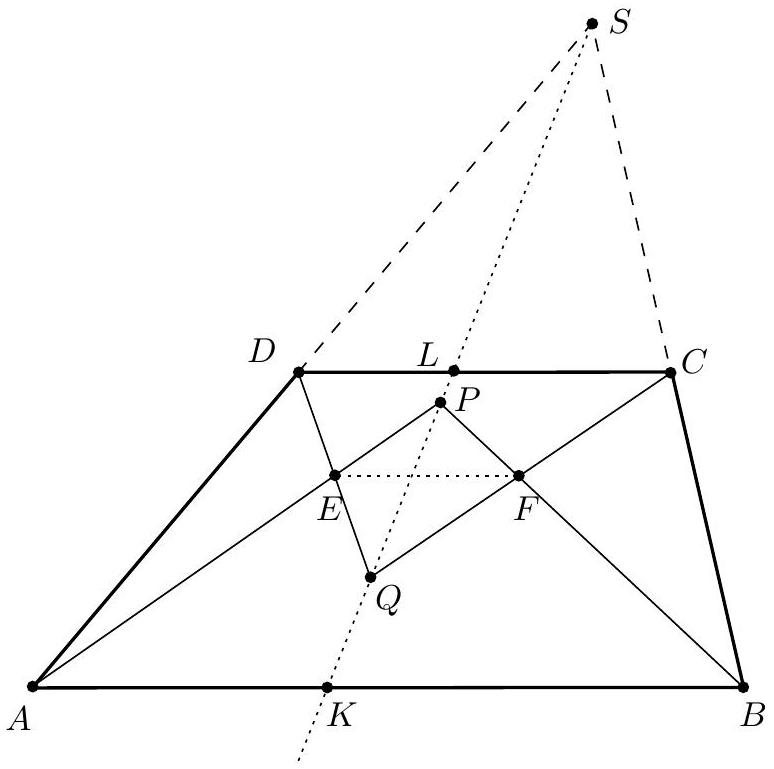
Let the lines and meet at , and let and meet at . Then and by the condition of the problem. Since the angles and add up to , it follows that is a cyclic quadrilateral.
Applying Menelaus' theorem, first to triangle and line and then to triangle and line , we have
The first factors in these equations are equal, as . Thus the last factors are also equal, which implies that is parallel to and . Using this and the cyclicity of , we obtain
On the other hand,
and consequently . The latter angle either coincides with or is supplementary to , depending on whether lies between and or not. In either case it follows that , , and are concyclic.
Want a route through all this instead of an archive? The track
puts 2,604 problems in a working order, from Junior Challenge level to the IMO shortlist.