Consider a lattice of side length equilateral triangles forming a regular hexagon of side length . Show that the number of ways of simultaneously selecting six vertices of the lattice to form the vertices of a regular hexagon is a perfect square.
Balkan Mathematical Olympiad Shortlist
Solution
By a lattice hexagon we will mean a regular hexagon whose sides run along edges of the lattice. Given any regular hexagon , we construct a lattice hexagon whose edges pass through the vertices of , as shown in the figure, which we will call the enveloping lattice hexagon of . Given a lattice hexagon of side length , the number of regular hexagons whose enveloping lattice hexagon is is exactly .
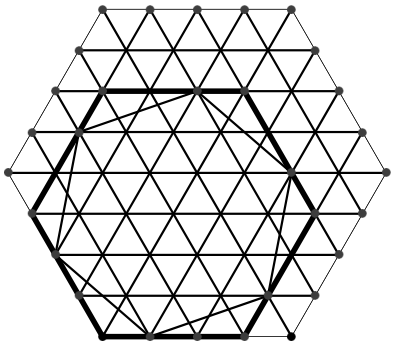
Yet also there are precisely lattice hexagons of side length in our lattice: they are those with centres lying at most steps from the centre of the lattice. In particular, the total number of regular hexagons equals
Since , and it is easily checked that .
Want a route through all this instead of an archive? The track
puts 2,604 problems in a working order, from Junior Challenge level to the IMO shortlist.