Maths Olympiad Prep

Library / /32 of 92

Geometry Difficulty 6.2 National olympiad Prove it Iran

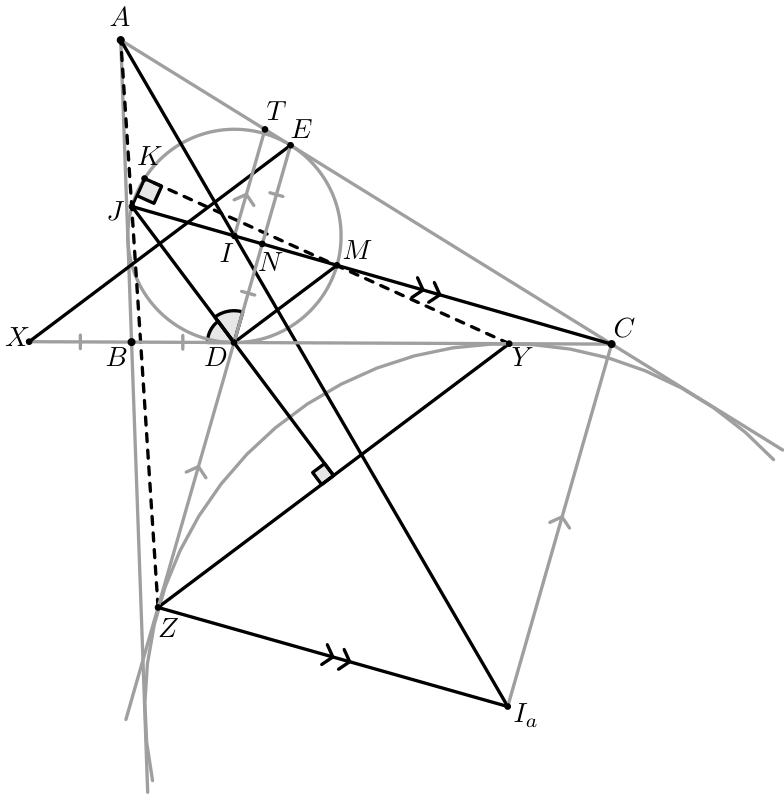
Incircle ω\omega of triangle ABCABC is tangent to sides CBCB and CACA at DD and EE, respectively. Point XX is the reflection of DD with respect to BB. Suppose that the line DEDE is tangent to the AA-excircle at ZZ. Let the circumcircle of triangle XZEXZE intersects ω\omega at KK, for the second time. Prove that the intersection of BKBK and AZAZ lies on ω\omega.

Solution

Let II be the incenter and IaI_a the AA-excenter of triangle ABCABC and JJ the CC-excenter of triangle CDECDE. JJ lies on ω\omega, since
EJD=9012ECD=CDE. \angle EJD = 90^\circ - \frac{1}{2}\angle ECD = \angle CDE.
We claim that AA, JJ, and ZZ are collinear. Point TT lies on ACAC such that ITDEIT \parallel DE. To prove our claim, we just need to show that IJIT=IaZIaC\frac{IJ}{IT} = \frac{I_a Z}{I_a C}, since ITCIaIT \parallel CI_a, IJIaZIJ \parallel I_a Z and IIaII_a passes through AA. Notice that
ITE=DEC=EDC=IaCY    IETIaYC    IEIT=IaYIaC, \angle ITE = \angle DEC = \angle EDC = \angle I_a CY \implies \triangle IET \sim \triangle I_a YC \implies \frac{IE}{IT} = \frac{I_a Y}{I_a C},
hence IJIT=IaZIaC\frac{IJ}{IT} = \frac{I_a Z}{I_a C}, since IE=IJIE = IJ and IaY=IaZI_a Y = I_a Z. So the claim is proved. Let BCBC touches AA-excircle at YY. The extensions of sides of quadrilateral AEDBAEDB are tangent to AA-excircle, therefore
AE+ED=AB+BD    ED=2BD.(1) AE + ED = AB + BD \implies ED = 2BD. \quad (1)
Yielding DX=DEDX = DE, and it is obvious that DY=DZDY = DZ so quadrilateral YZXEYZXE is an isosceles trapezoid and YY lies on the circumcircle of triangle XZEXZE. Hence
EKY=EZY=12EDY=EDM, \angle EKY = \angle EZY = \frac{1}{2}\angle EDY = \angle EDM,
where MM is the midpoint of arc EDED (not containing JJ), so KYKY passes through MM. Let NN be the midpoint of segment EDED. Notice that CDICND\triangle CDI \sim \triangle CND, hence
DNCD=IDIC    (1)BDCD=IJIC    JBID. \frac{DN}{CD} = \frac{ID}{IC} \stackrel{(1)}{\implies} \frac{BD}{CD} = \frac{IJ}{IC} \implies JB \parallel ID.

therefore YJD=BKD\angle YJD = \angle BKD, since BJY=BKY\angle BJY = \angle BKY. According to our assumption, JJ lies on the angle bisector of YDZ\angle YDZ and YD=DZYD = DZ. It yields that JDJD is the perpendicular bisector of YZYZ and YJD=ZJD\angle YJD = \angle ZJD. Hence ZJD=BKD\angle ZJD = \angle BKD and the result follows.

Figure 1

Want a route through all this instead of an archive? The track puts 2,000 problems in a working order, from AMC 10 level to the IMO shortlist.

Source: MathNet, licensed CC-BY-4.0. Statement and solution reproduced as published; topic and difficulty added by this site.