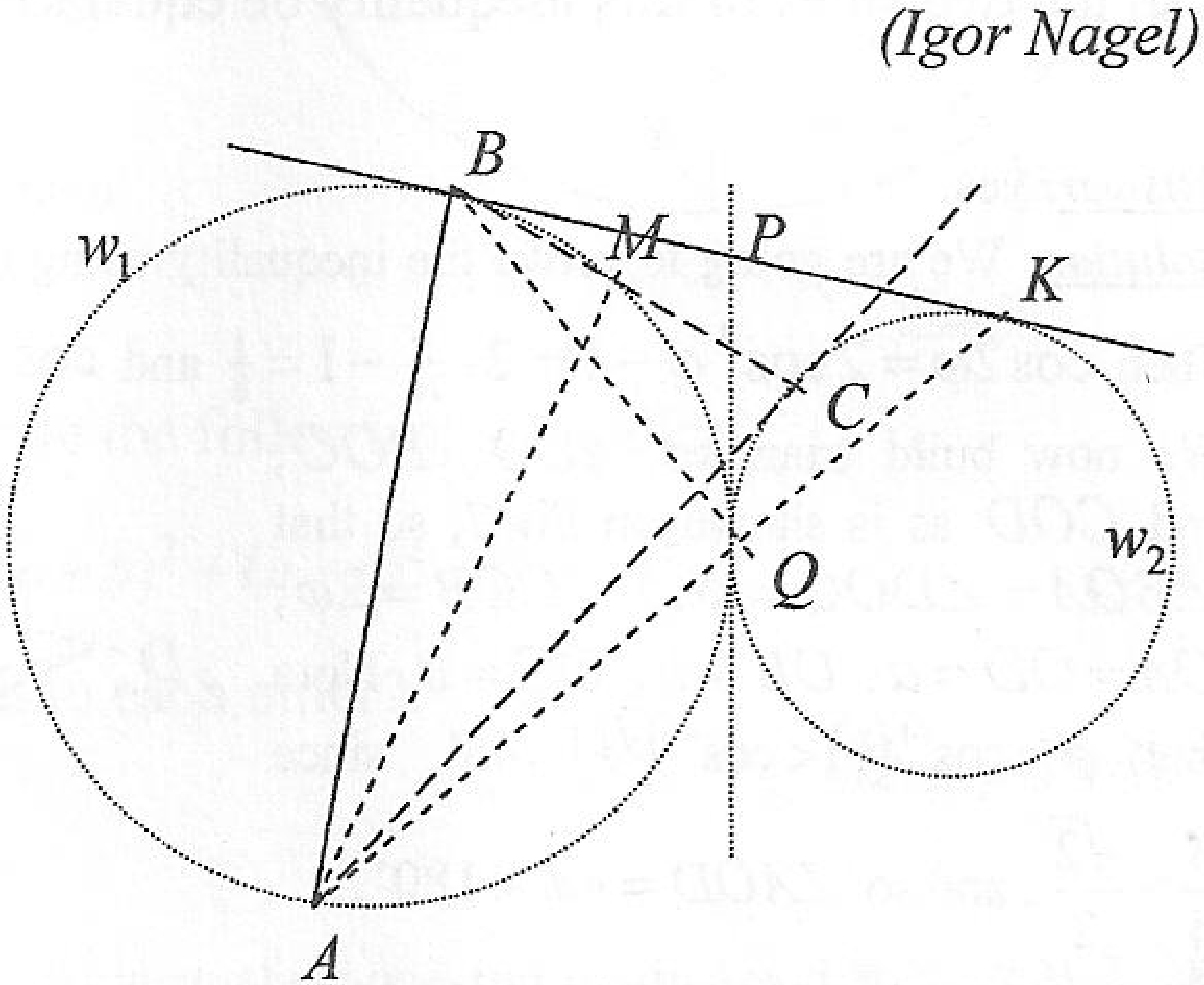
Let K be the point where the common tangent touches the circle w2 (Fig. 6). Consider the common tangent line to the two circles that passes through the point Q. Suppose it intersects the line BK at a point P. By the properties of lines tangent to circles,
PB=PQ=PK.
Therefore, ∠BQK=90∘. Since AB is a diameter of w1, we have that ∠AQB=90∘, and so the points A,Q,K are collinear. It is given in the problem statement that AB⊥BK, which implies that
AB2=AQ⋅AK and AC2=AQ⋅AK
(from the properties of the right triangle △ABK and the properties of secant and tangent lines to the circle w2). It then follows that AB=AC. If w1 intersects BC at a point M, then ∠BMA=90∘, and so AM is the altitude of the isosceles triangle △ABC. This proves that BM=MC, as required.