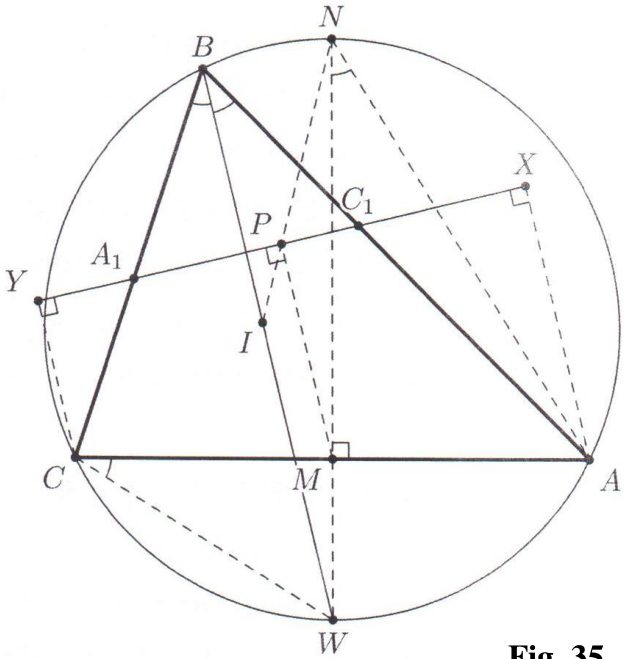
Let's denote the second intersection point of the line BI with the circumcircle of △ABC as W (fig. 35).
Clearly, W is a midpoint of the smaller arc AC, and points M, W, and N lie on the same line.
Hence, it is enough to prove that triangles PMN and IWN are similar (which will imply that ∠PNM=∠INW and the desired collinearity). In order to prove the similarity, we are going to show that NWNM=IWPM.
Let ∠B=2β, then ∠MNA=β and
NWNM=IWPM⋅NWNA=cos2β.
Considering a segment PM yields that PM is a midline of a trapezoid AXYC, where X, Y are the projections of A and C onto the line A1C1 respectively. Going further, we get
2PM=CY+XA=CA1sinYA1C+C1sinXC1A=(CA1+AC1)cosβ=ACcosβ,
because ∠YA1C=∠XC1A=90∘−β, and CA1+AC1=AC, because A1 and C1 are the points in which inscribed circle touches the sides of a triangle △ABC.
Finally, from the trillium theorem, IW=CW, meaning that
IWPM=2CWACcosβ=CWCMcosβ=cos2β,
finishing the proof.