Points X, Y and Z are marked on the sides AD, AB and BC of a parallelogram ABCD, respectively. It is known that AX=CZ.
a) Prove that at least one of the inequalities holds XY+YZ≥AC or XY+YZ≥BD.
b) Is it true that XY+YZ≥2AC+BD?
Solution
b) It is not true.
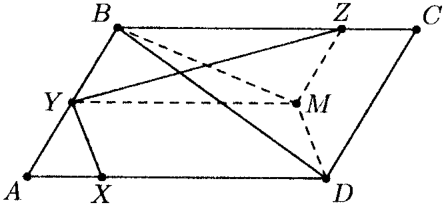
a) Without loss of generality we assume that α=∠BAD≤90∘. In this case we have BD=AB2+AD2−2AB⋅ADcosα≤≤AB2+AD2+2AB⋅ADcosα=[AD=BC]==AB2+BC2−2AB⋅BCcos(π−α)=AC. So, it is sufficient to show that XY+YZ≥BD. Let YM∥AD, DM∥XY (see the Fig.). It is evident that XYMD is a parallelogram, so YM=XD and XY=MD. Since CZ=AX, we have XD=AD−AX=BC−CZ=ZB. Since ZB∥XD∥YM, we see that YBZM is a parallelogram.
In the parallelogram YBZM we have ∠BYM=∠BAD=α≤90∘, therefore, YZ=YB2+BZ2−2YB⋅BZcos(π−α)≥[BZ=YM]≥≥YB2+YM2−2YB⋅YMcosα=BM. Thus XY+YZ≥XY+BM=MD+BM≥BD, as required.
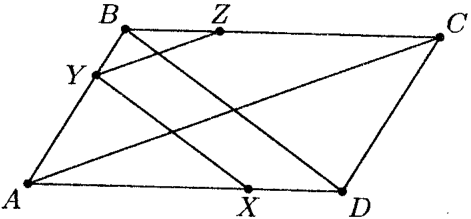
b) We show that there exist a parallelogram ABCD and a point Y such that the inequality XY+YZ≥2AC+BD(∗) is not valid. Let a parallelogram ABCD is different from a rectangle. Then its diagonals are not equal. Without loss of generality we assume that AC>BD. Let YZ∥AC (see the Fig.). Let AX/AD=CZ/BC=λ. By Thales' theorem, we have AY/AB=CZ/BC=λ. Hence AY/AB=AX/AD=λ. It follows that the triangles AYX and ABD are similar and XY/BD=λ, i.e. XY=λBD.
Moreover, by construction of Y, the triangles YBZ and ABC are similar and YZ/AC=BZ/BC=(BC−CZ)/BC=1−λ, hence YZ=(1−λ)AC.
Therefore, XY+YZ=λBD+(1−λ)AC and (*) has the form λBD+(1−λ)AC≥21BD+21AC or (λ−21)BD≥(λ−21)AC. But this inequality is not valid if λ>21.
Want a route through all this instead of an archive? The track
puts 2,604 problems in a working order, from Junior Challenge level to the IMO shortlist.
Source: MathNet,
licensed CC-BY-4.0.
Statement reproduced verbatim; metadata (topic, difficulty) added by this project.