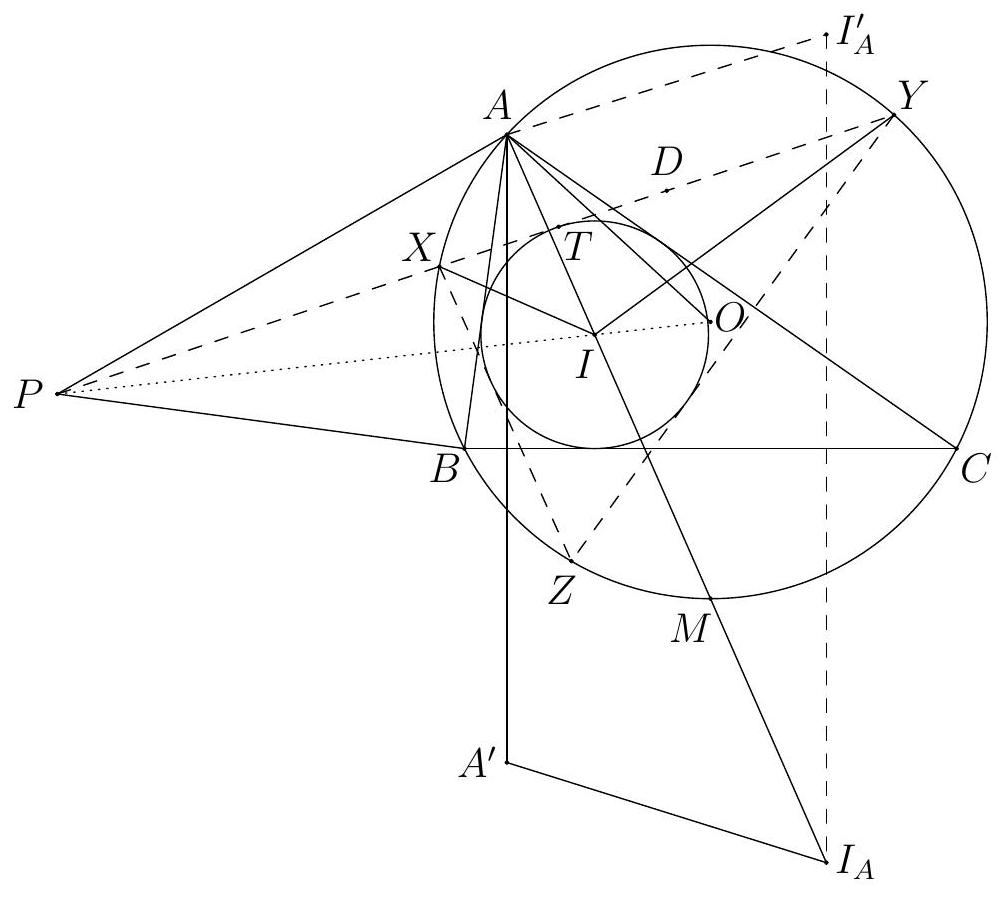
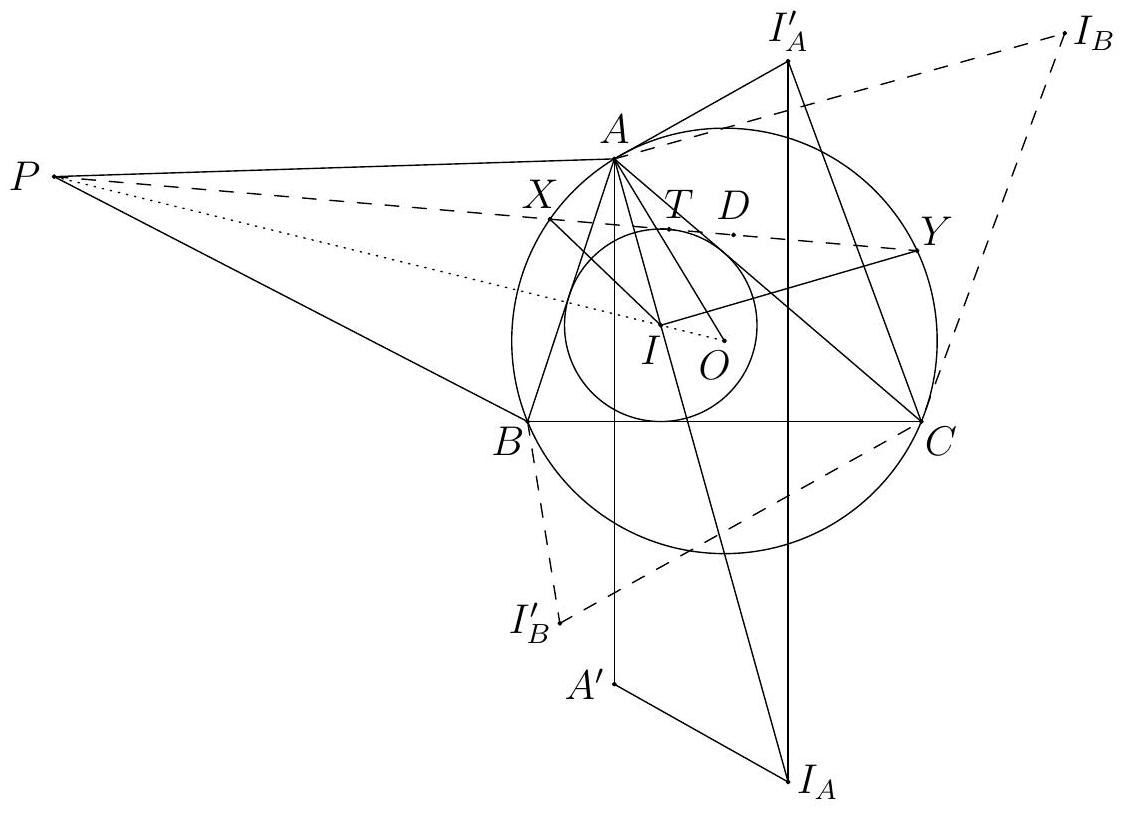
Let I be the incentre of a non-equilateral triangle ABC, IA be the A-excentre, IA′ be the reflection of IA in BC, and lA be the reflection of line AIA′ in AI. Define points IB,IB′ and line lB analogously. Let P be the intersection point of lA and lB.
a. Prove that P lies on line OI where O is the circumcentre of triangle ABC.
b. Let one of the tangents from P to the incircle of triangle ABC meet the circumcircle at points X and Y. Show that ∠XIY=120∘.
Solutions — 2
Solution 1
a. Let A′ be the reflection of A in BC and let M be the second intersection of line AI and the circumcircle Γ of triangle ABC. As triangles ABA′ and AOC are isosceles with ∠ABA′=2∠ABC=∠AOC, they are similar to each other. Also, triangles ABIA and AIC are similar. Therefore we have AIAAA′=ABAA′⋅AIAAB=AOAC⋅ACAI=AOAI. Together with ∠A′AIA=∠IAO, we find that triangles AA′IA and AIO are similar. Denote by P′ the intersection of line AP and line OI. Using directed angles, we have ∡MAP′=∡IA′AIA=∡IA′AA′−∡IAAA′=∡AA′IA−∡(AM,OM)=∡AIO−∡AMO=∡MOP′ This shows M,O,A,P′ are concyclic. Denote by R and r the circumradius and inradius of triangle ABC. Then IP′=IOIA⋅IM=IOIO2−R2 is independent of A. Hence, BP also meets line OI at the same point P′ so that P′=P, and P lies on OI.
b. By Poncelet's Porism, the other tangents to the incircle of triangle ABC from X and Y meet at a point Z on Γ. Let T be the touching point of the incircle to XY, and let D be the midpoint of XY. We have OD=IT⋅IPOP=r(1+IPOI)=r(1+OI⋅IPOI2)=r(1+R2−IO2R2−2Rr)=r(1+2RrR2−2Rr)=2R=2OX This shows ∠XZY=60∘ and hence ∠XIY=120∘.
Solution 2
a. Note that triangles AIBC and IABC are similar since their corresponding interior angles are equal. Therefore, the four triangles AIB′C, AIBC, IABC and IA′BC are all similar. From △AIB′C∼△IA′BC, we get △AIA′C∼△IB′BC. From ∡ABP=∡IB′BC=∡AIA′C and ∡BAP=∡IA′AC, the triangles ABP and AIA′C are directly similar. Consider the inversion with centre A and radius AB⋅AC followed by the reflection in AI. Then B and C are mapped to each other, and I and IA are mapped to each other. From the similar triangles obtained, we have AP⋅AIA′=AB⋅AC so that P is mapped to IA′ under the transformation. In addition, line AO is mapped to the altitude from A, and hence O is mapped to the reflection of A in BC, which we call point A′. Note that AA′IAIA′ is an isosceles trapezoid, which shows it is inscribed in a circle. The preimage of this circle is a straight line, meaning that O,I,P are collinear.
b. Denote by R and r the circumradius and inradius of triangle ABC. Note that by the above transformation, we have △APO∼△AA′IA′ and △AA′IA∼△AIO. Therefore, we find that PO=A′IA′⋅AIA′AO=AIA⋅A′IAAO=A′IAAIA⋅AO=IOAO⋅AO This shows PO⋅IO=R2, and it follows that P and I are mapped to each other under the inversion with respect to the circumcircle Γ of triangle ABC. Then PX⋅PY, which is the power of P with respect to Γ, equals PI⋅PO. This yields X,I,O,Y are concyclic. Let T be the touching point of the incircle to XY, and let D be the midpoint of XY. Then OD=IT⋅PIPO=r⋅PO−IOPO=r⋅R2−IO2R2=r⋅2RrR2=2R. This shows ∠DOX=60∘ and hence ∠XIY=∠XOY=120∘.
Want a route through all this instead of an archive? The track
puts 2,604 problems in a working order, from Junior Challenge level to the IMO shortlist.
Source: MathNet,
licensed CC-BY-4.0.
Statement reproduced verbatim; metadata (topic, difficulty) added by this project.