Solution 1. Since
∠APB+∠BPC+∠CPA=2π=(π−∠ACB)+(π−∠BAC)+(π−∠CBA),
at least one of the following inequalities holds:
∠APB⩾π−∠ACB,∠BPC⩾π−∠BAC,∠CPA⩾π−∠CBA.
Without loss of generality, we assume that ∠BPC⩾π−∠BAC. We have ∠BPC>∠BAC because P is inside △ABC. So ∠BPC⩾max(∠BAC,π−∠BAC) and hence
sin∠BPC⩽sin∠BAC.(*)
Let the rays AP,BP, and CP cross the circumcircle Ω again at A3,B3, and C3, respectively. We will prove that at least one of the ratios B1B3PB1 and C1C3PC1 is at least 1, which yields that one of the points B2 and C2 does not lie strictly inside Ω.
Because A,B,C,B3 lie on a circle, the triangles CB1B3 and BB1A are similar, so
B1B3CB1=B1ABB1.
Applying the sine rule we obtain
B1B3PB1=CB1PB1⋅B1B3CB1=CB1PB1⋅B1ABB1=sin∠BPCsin∠ACP⋅sin∠PBAsin∠BAC.
Similarly,
C1C3PC1=sin∠BPCsin∠PBA⋅sin∠ACPsin∠BAC.
Multiplying these two equations we get
B1B3PB1⋅C1C3PC1=sin2∠BPCsin2∠BAC⩾1
using (*), which yields the desired conclusion.
Solution 2. Define points A3,B3, and C3 as in Solution 1. Assume for the sake of contradiction that A2,B2, and C2 all lie strictly inside circle ABC. It follows that PA1<A1A3, PB1<B1B3, and PC1<C1C3.
Observe that △PBC3∼△PCB3. Let X be the point on side PB3 that corresponds to point C1 on side PC3 under this similarity. In other words, X lies on segment PB3 and satisfies PX:XB3=PC1:C1C3. It follows that
∠XCP=∠PBC1=∠B3BA=∠B3CB1
Hence lines CX and CB1 are isogonal conjugates in △PCB3.
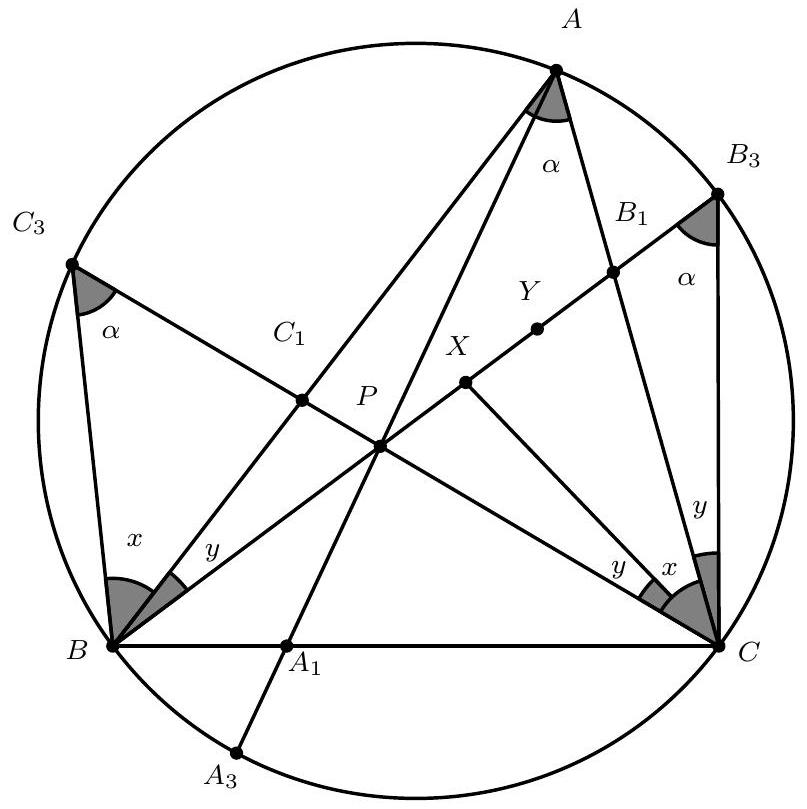
Let Y be the foot of the bisector of ∠B3CP in △PCB3. Since PC1<C1C3, we have PX<XB3. Also, we have PY<YB3 because PB1<B1B3 and Y lies between X and B1. By the angle bisector theorem in △PCB3, we have PY:YB3=PC:CB3. So PC<CB3 and it follows that ∠PB3C<∠CPB3. Now since ∠PB3C=∠BB3C=∠BAC, we have
∠BAC<∠CPB3.
Similarly, we have
∠CBA<∠APC3and∠ACB<∠BPA3=∠B3PA.
Adding these three inequalities yields π<π, and this contradiction concludes the proof.
Solution 3. Choose coordinates such that the circumcentre of △ABC is at the origin and the circumradius is 1. Then we may think of A,B, and C as vectors in R2 such that
∣A∣2=∣B∣2=∣C∣2=1.
P may be represented as a convex combination αA+βB+γC where α,β,γ>0 and α+β+γ=1. Then
A1=β+γβB+γC=1−α1P−1−ααA,
so
A2=2A1−P=1−α1+αP−1−α2αA
Hence
∣A2∣2=(1−α1+α)2∣P∣2+(1−α2α)2∣A∣2−(1−α)24α(1+α)A⋅P.
Using ∣A∣2=1 we obtain
2(1+α)(1−α)2∣A2∣2=21+α∣P∣2+1+α2α2−2αA⋅P.(1)
Likewise
2(1+β)(1−β)2∣B2∣2=21+β∣P∣2+1+β2β2−2βB⋅P(2)
and
2(1+γ)(1−γ)2∣C2∣2=21+γ∣P∣2+1+γ2γ2−2γC⋅P.(3)
Summing (1), (2) and (3) we obtain on the LHS the positive linear combination
LHS=2(1+α)(1−α)2∣A2∣2+2(1+β)(1−β)2∣B2∣2+2(1+γ)(1−γ)2∣C2∣2
and on the RHS the quantity
(21+α+21+β+21+γ)∣P∣2+(1+α2α2+1+β2β2+1+γ2γ2)−2(αA⋅P+βB⋅P+γC⋅P).
The first term is 2∣P∣2 and the last term is −2P⋅P, so
RHS=(1+α2α2+1+β2β2+1+γ2γ2)=23α−1+2(1+α)(1−α)2+23β−1+2(1+β)(1−β)2+23γ−1+2(1+γ)(1−γ)2=2(1+α)(1−α)2+2(1+β)(1−β)2+2(1+γ)(1−γ)2
Here we used the fact that
23α−1+23β−1+23γ−1=0.
We have shown that a linear combination of ∣A2∣2,∣B2∣2, and ∣C2∣2 with positive coefficients is equal to the sum of the coefficients. Therefore at least one of ∣A2∣2,∣B2∣2, and ∣C2∣2 must be at least 1, as required.