Maths Olympiad Prep

Library / /87 of 100

Geometry Difficulty 6.0 National olympiad Prove it China

Given two moving points A(x1,y1)A(x_1, y_1) and B(x2,y2)B(x_2, y_2) on parabola curve y2=6xy^2 = 6x with x1+x2=4x_1 + x_2 = 4 and x1x2x_1 \neq x_2, and the perpendicular bisector of segment ABAB intersects xx-axis at point CC. Find the maximum area of ABC\triangle ABC.

Solutions — 2

Solution 1

Let the midpoint of ABAB be M(x0,y0)M(x_0, y_0). Then x0=x1+x22=2x_0 = \frac{x_1 + x_2}{2} = 2 and y0=y1+y22y_0 = \frac{y_1 + y_2}{2}. We have
kAB=y2y1x2x1=y26y16y26+y16=6y2+6y16y2+6y1=3y0. k_{AB} = \frac{y_2 - y_1}{x_2 - x_1} = \frac{\frac{y_2}{6} - \frac{y_1}{6}}{\frac{y_2}{6} + \frac{y_1}{6}} = \frac{\frac{6}{y_2} + \frac{6}{y_1}}{\frac{6}{y_2} + \frac{6}{y_1}} = \frac{3}{y_0}.
The equation of the perpendicular bisector of ABAB is
yy0=y03(x2).1 y - y_0 = -\frac{y_0}{3}(x - 2). \qquad \textcircled{1}
It is easy to find that one solution of it is x=5x = 5, y=0y = 0.
Therefore, the intersection CC is a fixed point with coordinate (5,0)(5, 0).
From ①, we know the equation of line ABAB is yy0=3y0(x2)y - y_0 = \frac{3}{y_0}(x - 2), or
x=y03(yy0)+2.2 x = \frac{y_0}{3}(y - y_0) + 2. \qquad \textcircled{2}
Substituting ② in y2=6xy^2 = 6x, we get y2=2y0(yy0)+12y^2 = 2y_0(y - y_0) + 12, or
y22y0y+2y0212=0.3 y^2 - 2y_0y + 2y_0^2 - 12 = 0. \qquad \textcircled{3}
As y1y_1 and y2y_2 are two real roots of ③ and y1y2y_1 \neq y_2, we have
Δ=4y024(2y0212)=4y02+48>0. \Delta = 4y_0^2 - 4(2y_0^2 - 12) = -4y_0^2 + 48 > 0.
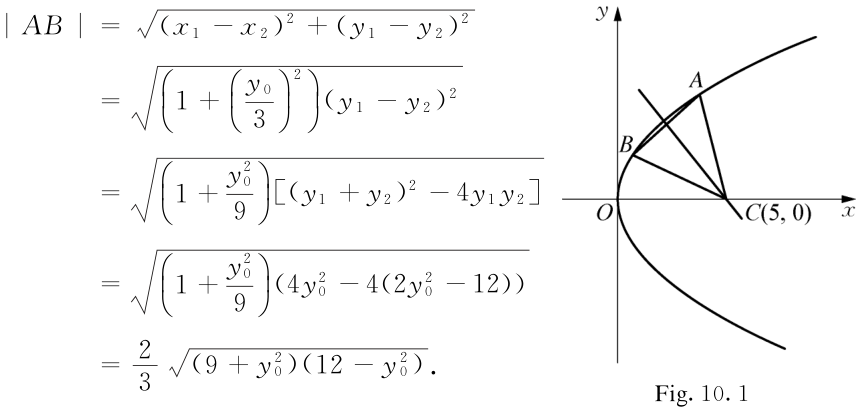
Therefore, 23<y0<23-2\sqrt{3} < y_0 < 2\sqrt{3}. Then we have
Figure 1
The distance from point C(5,0)C(5, 0) to segment ABAB is
h=CM=(52)2+(0y0)2=9+y02. h = |CM| = \sqrt{(5-2)^2 + (0-y_0)^2} = \sqrt{9+y_0^2}.
Therefore,
SABC=12ABh=13(9+y02)(12y02)9+y02=1312(9+y02)(242y02)(9+y02)1312(9+y02+242y02+9+y023)3=1437. \begin{align*} S_{\triangle ABC} &= \frac{1}{2} |AB| \cdot h = \frac{1}{3} \sqrt{(9+y_0^2)(12-y_0^2)} \cdot \sqrt{9+y_0^2} \\ &= \frac{1}{3} \sqrt{\frac{1}{2}(9+y_0^2)(24-2y_0^2)(9+y_0^2)} \\ &\le \frac{1}{3} \sqrt{\frac{1}{2} \left( \frac{9+y_0^2+24-2y_0^2+9+y_0^2}{3} \right)^3} \\ &= \frac{14}{3}\sqrt{7}. \end{align*}
The equality holds if and only if 9+y02=242y029 + y_0^2 = 24 - 2y_0^2, i.e.
y0=±5. Then we get y_0 = \pm\sqrt{5}. \text{ Then we get}
andA(6+353,5+7),B(6353,57) \text{and} \quad A\left(\frac{6+\sqrt{35}}{3}, \sqrt{5}+\sqrt{7}\right), B\left(\frac{6-\sqrt{35}}{3}, \sqrt{5}-\sqrt{7}\right)
A(6+353,(5+7)),B(6353,5+7). A\left(\frac{6+\sqrt{35}}{3}, - (\sqrt{5}+\sqrt{7})\right), B\left(\frac{6-\sqrt{35}}{3}, -\sqrt{5}+\sqrt{7}\right).

Solution 2

Similar to Solution 1, we get that CC, the intersection of the perpendicular bisector of ABAB and the xx-axis, is a fixed point with coordinate (5,0)(5, 0).
Let x1=t12x_1 = t_1^2, x2=t22x_2 = t_2^2, t1>t2t_1 > t_2, t12+t22=4t_1^2 + t_2^2 = 4. Then SABCS_{\triangle ABC} is the absolute value of
12501t126t11t226t21, \frac{1}{2} \begin{vmatrix} 5 & 0 & 1 \\ t_1^2 & \sqrt{6} t_1 & 1 \\ t_2^2 & \sqrt{6} t_2 & 1 \end{vmatrix},
so
SABC2=(12(56t1+6t12t26t1t2256t2))2=32(t1t2)2(t1t2+5)2=32(42t1t2)(t1t2+5)(t1t2+5)32(143)3. \begin{aligned} S_{\triangle ABC}^2 &= \left( \frac{1}{2} (5\sqrt{6} t_1 + \sqrt{6} t_1^2 t_2 - \sqrt{6} t_1 t_2^2 - 5\sqrt{6} t_2) \right)^2 \\ &= \frac{3}{2} (t_1 - t_2)^2 (t_1 t_2 + 5)^2 \\ &= \frac{3}{2} (4 - 2t_1t_2)(t_1t_2 + 5)(t_1t_2 + 5) \\ &\le \frac{3}{2} \left( \frac{14}{3} \right)^3. \end{aligned}
Therefore, SABC1437S_{\triangle ABC} \le \frac{14}{3}\sqrt{7} and the equality holds if and only if (t1t2)2=t1t2+5(t_1 - t_2)^2 = t_1t_2 + 5 and t12+t22=4t_1^2 + t_2^2 = 4. We then get t1=7+56t_1 = \frac{\sqrt{7} + \sqrt{5}}{\sqrt{6}} and t2=756t_2 = -\frac{\sqrt{7} - \sqrt{5}}{\sqrt{6}}, which implies either
A(6+353,5+7),B(6353,57) A\left(\frac{6 + \sqrt{35}}{3}, \sqrt{5} + \sqrt{7}\right), B\left(\frac{6 - \sqrt{35}}{3}, \sqrt{5} - \sqrt{7}\right)
or
A(6+353,(5+7)),B(6353,5+7). A\left(\frac{6 + \sqrt{35}}{3}, - (\sqrt{5} + \sqrt{7})\right), B\left(\frac{6 - \sqrt{35}}{3}, -\sqrt{5} + \sqrt{7}\right).

Want a route through all this instead of an archive? The track puts 2,000 problems in a working order, from AMC 10 level to the IMO shortlist.

Source: MathNet, licensed CC-BY-4.0. Statement and solution reproduced as published; topic and difficulty added by this site.