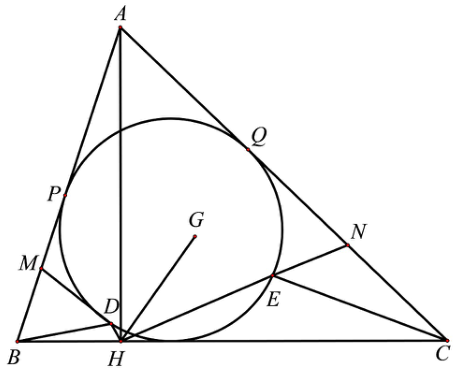
As shown in the figure, in an acute triangle with , let be its altitude and the barycentre. Let be the tangent points of the incircle to , respectively. Let be the midpoint of , respectively. Let be two points lying on the incircle of the triangle such that
Prove that the lines are concurrent.
Chinese Girls' Mathematical Olympiad
Solution
Proof: On the circumcircle of , a point is chosen such that forms an isosceles trapezoid. The line intersects the circumcircle of at another point , and intersects the median at point . As shown in the figure.
Since , it follows that , implying that is the centroid of , hence . Therefore,
Given , it follows that , which means points are concyclic.
Similarly, it can be proved that , and points are concyclic.
Since , is tangent to circle at point . Let the incircle of be , and is an external common tangent of and . Given , it is known that is the radical center of and , thus line is the radical axis of and .
Similarly, it can be proved that line is the radical axis of and . Moreover, line is the radical axis of and , therefore lines either intersect at a single point, or are pairwise parallel.
If are pairwise parallel, then the centers of , and the center of are collinear. Since both and are obtuse, are below , obviously is above . Let the projections of
on be respectively, then are the midpoints of respectively. Given , it is known that are on the same side of , and
Hence, lies on the segment , therefore cannot be collinear, a contradiction. Thus, intersect at a single point.
Want a route through all this instead of an archive? The track
puts 2,604 problems in a working order, from Junior Challenge level to the IMO shortlist.