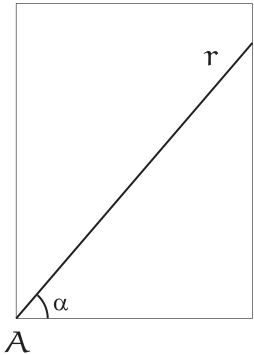
Line r passes through the corner A of a sheet of paper and makes an angle α with the horizontal border, as shown in figure 1. In order to divide α into three equal parts we proceed as follows:
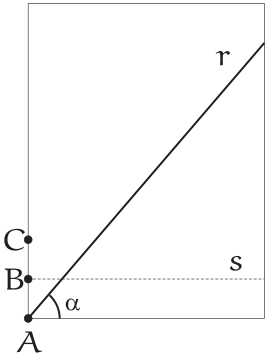
a) initially we mark two points B and C on the vertical border such that AB=BC; through B we draw a line s parallel to the border (figure 2);
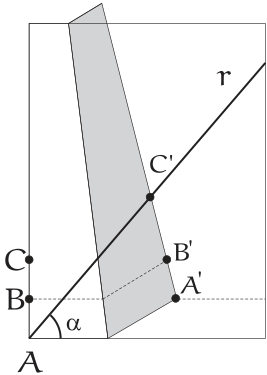
b) after that, we fold the sheet so as to make C coincide with a point C′ on the line r and A with a point A′ on line s (figure 3); we call B′ the point which coincides with B.
Figure 1 Figure 2 Figure 3
Show that lines AA′ and AB′ divides angle α into three equal parts.
Solution
Let P and X be the points determined by the crease in the lower horizontal border of the sheet and on the line s, respectively. Let β=∠PAA′. Since AP=AP′, ∠PA′A=∠AA′B=β, thus ∠PA′X=2β. Moreover △APX≅△A′PX, so that ∠XAA′=∠XAP−β=β.
Now observe that ∠BXA=2β and, since A′P∥B′P, ∠B′XA′=2β also. Thus A,X and B′ are collinear. Therefore AB′ is a median and height of △C′AA′, so AB′ is also an angle bisector of ∠C′AA′. Thus ∠C′AB′=∠B′AA′=∠A′AP=β.
Want a route through all this instead of an archive? The track
puts 2,604 problems in a working order, from Junior Challenge level to the IMO shortlist.
Source: MathNet,
licensed CC-BY-4.0.
Statement reproduced verbatim; metadata (topic, difficulty) added by this project.