Problem:
Given a cube with unit side (see figure), consider the plane containing the edges and and the one containing the edges and . These two planes cut the cube into four parts. What is the maximum among the volumes of these parts?
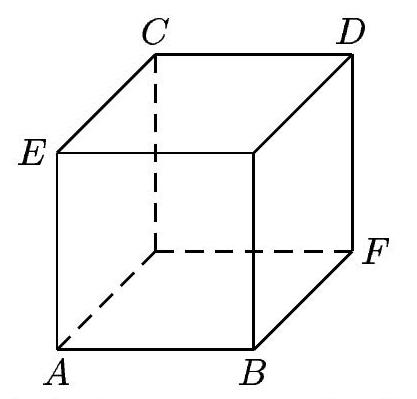
Problem:
Given a cube with unit side (see figure), consider the plane containing the edges and and the one containing the edges and . These two planes cut the cube into four parts. What is the maximum among the volumes of these parts?
Pick one
Solution:
The answer is (B). Let and be the other two vertices of the cube, with an edge of the cube. Let us fix a Cartesian reference frame, with origin at and axes , and along . The four regions are characterized by the conditions . Let us cut the cube with a third plane, passing through and . The resulting regions are six and are characterized by the conditions and similar ones, obtained by permuting the unknowns.
This implies, among other things, that of the four initial regions, two are cut by the third plane (and these are the ones that will turn out to have maximum volume), while the other two are not.
The six regions obtained are all congruent, by symmetry reasons, and therefore each has volume . From this it follows that of the four regions described in the question, two have volume and two have volume .
Solution:
It is easy to verify that the pyramid with base and vertex at is not cut by the planes in question. Moreover, of the five faces of the pyramid, three are also faces of the cube (or parts of them), while the remaining two are coplanar with the cutting planes.
This means that the pyramid is one of the four regions into which the cube is cut. Similarly, the symmetric pyramid is another of these regions. Since each of them has volume , the remaining two parts cannot have a greater volume, so the maximum of the volumes is .