Maths Olympiad Prep

Library / Estonian Math Competitions /73 of 148

Estonian Math Competitions

Geometry Difficulty 5.7 AIME, harder Prove it Estonia

Let ABCABC be a triangle where AB=ACAB = AC. Let EE be the foot of its altitude from the vertex BB. Given that either BEABEA or BECBEC is an isosceles triangle, find all possibilities of the size of the angle at the vertex AA of the triangle ABCABC.

Solutions — 2

Solution 1

Answer: 45∘45^\circ, 90∘90^\circ, 135∘135^\circ.

Let α=∠BAC\alpha = \angle BAC. Both triangles BEABEA and BECBEC have right angle at vertex EE. Hence these triangles can be isosceles only if their other angles have size 45∘45^\circ.

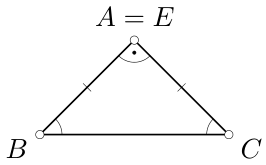
Suppose that BECBEC is isosceles (see figure below).
Then ∠BCE=45∘\angle BCE = 45^\circ. Since ∠BCE=∠BCA=180∘−α2\angle BCE = \angle BCA = \frac{180^\circ - \alpha}{2}, we have α=180∘−2⋅45∘=90∘\alpha = 180^\circ - 2 \cdot 45^\circ = 90^\circ.

Suppose now that BEABEA is isosceles. Then ∠BAE=45∘\angle BAE = 45^\circ.
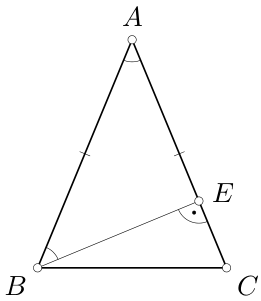
If EE lies on the line segment ACAC (see figure below) then ∠BAE=∠BAC=α\angle BAE = \angle BAC = \alpha, implying α=45∘\alpha = 45^\circ.
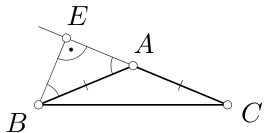
If EE lies outside the line segment ACAC (see figure below) then ∠BAE=180∘−∠BAC=180∘−α\angle BAE = 180^\circ - \angle BAC = 180^\circ - \alpha, implying α=180∘−45∘=135∘\alpha = 180^\circ - 45^\circ = 135^\circ.

Figure 1

Figure 2

Figure 3

Solution 2

Let α=∠BAC\alpha = \angle BAC. Then ∠ABC=∠ACB=180∘−α2\angle ABC = \angle ACB = \frac{180^\circ - \alpha}{2} and ∠EBC=90∘−180∘−α2=α2\angle EBC = 90^\circ - \frac{180^\circ - \alpha}{2} = \frac{\alpha}{2}.
Both triangles BEABEA and BECBEC have right angle at vertex EE. Hence these triangles can be isosceles only if their other two angles have equal size.

Suppose that BECBEC is isosceles. Then 180∘−α2=α2\frac{180^\circ - \alpha}{2} = \frac{\alpha}{2}, implying α=90∘\alpha = 90^\circ.

Suppose now that BEABEA is isosceles. If the triangle ABCABC is acute, we must have ∠BAE=α\angle BAE = \alpha and ∠ABE=180∘−α2−α2=90∘−α\angle ABE = \frac{180^\circ - \alpha}{2} - \frac{\alpha}{2} = 90^\circ - \alpha. Thus α=90∘−α\alpha = 90^\circ - \alpha, implying α=45∘\alpha = 45^\circ.
If the triangle ABCABC is obtuse then ∠BAE=180∘−α\angle BAE = 180^\circ - \alpha and ∠ABE=α2−180∘−α2=α−90∘\angle ABE = \frac{\alpha}{2} - \frac{180^\circ - \alpha}{2} = \alpha - 90^\circ. Hence 180∘−α=α−90∘180^\circ - \alpha = \alpha - 90^\circ, implying α=135∘\alpha = 135^\circ.
The triangle ABCABC is not right as, otherwise, the triangle BEABEA would have two right angles.

Figure 1

Figure 2

Figure 3

Want a route through all this instead of an archive? The track puts 2,604 problems in a working order, from Junior Challenge level to the IMO shortlist.

Source: MathNet, licensed CC-BY-4.0. Statement reproduced verbatim; metadata (topic, difficulty) added by this project.