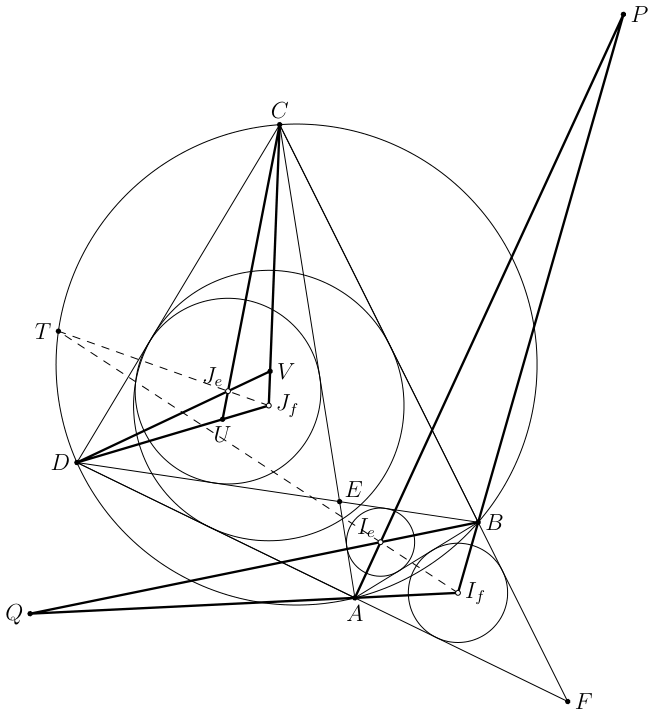
The quadrilateral ABCD is inscribed in the circle k. The lines AC and BD meet in E and the lines AD and BC meet in F. Show that the line through the incenters of △ABE and △ABF and the line through the incenters of △CDE and △CDF meet on k.
Solution
Let Ie,If,Je,Jf be the incenters of △ABE,△ABF,△CDE,△CDF, respectively. Let P=AIe∩BIf, Q=AIf∩BIe, U=CJe∩DJf, and V=CJf∩DJe be the excenter of △ABC opposite to A, the excenter of △ABD opposite to B, the incenter of △ACD, and the incenter of △BCD, respectively.
We have ∠APB=21AB=∠AQB; therefore, ABPQ is cyclic. Analogously, CDUV is cyclic.
We have ∠APB=21AB=∠UCV, ∠AQB=21AB=∠UDV, ∠APQ=∠ABQ=21AD=∠UCD, and ∠BQP=∠BAP=21BC=∠VDC. Therefore, the figures ABPQ and UVCD are similar and identically oriented. Let T be their center of similitude. (I.e., let T be the fixed point of the unique similitude which maps A,B,P,Q onto U,V,C,D, respectively.)
We have △TAQ∼△TUD; therefore, △TAU∼△TQD and ∠ATQ=∠(AU,QD)=21AD=∠AIeQ. It follows that T lies on the circumcircle of △AIeQ. Analogously, T lies on the circumcircle of △BIeP,△CJeV, and △DJeU.
We have, then, ∠ATB=∠ATIe+∠IeTB=∠AQB+∠APB=21AB+21AB=AB, showing that T lies on k.
Let T′∈IfIe so that IfA⋅IfQ=IfIe⋅IfT′=IfB⋅IfP. Then T′ is a point other than Ie which lies on the circumcircles of both △AIeQ and △BIeP; therefore, T′≡T and T∈IeIf.
Analogously, T∈JeJf, and we are done.
Want a route through all this instead of an archive? The track
puts 2,604 problems in a working order, from Junior Challenge level to the IMO shortlist.
Source: MathNet,
licensed CC-BY-4.0.
Statement reproduced verbatim; metadata (topic, difficulty) added by this project.