Maths Olympiad Prep

Library / /121 of 133

Geometry Difficulty 6.9 National olympiad Prove it Saudi Arabia

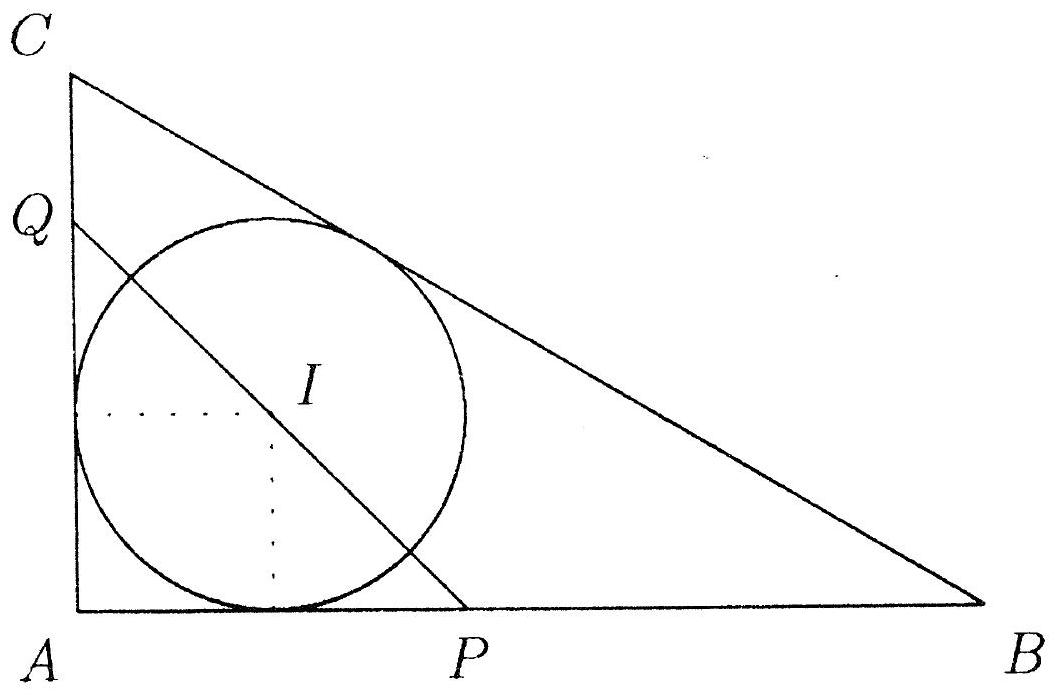
Let ABCABC be a right angled triangle with A^=90\widehat{A}=90^{\circ} and BC=aBC=a, AC=bAC=b, AB=cAB=c. Let dd be a line passing through the incenter of triangle and intersecting the sides ABAB and ACAC in PP and QQ, respectively.

a. Prove that
bPBPA+cQCQA=a; b \cdot \frac{PB}{PA} + c \cdot \frac{QC}{QA} = a ;

b. Find the minimum of
(PBPA)2+(QCQA)2. \left(\frac{PB}{PA}\right)^{2} + \left(\frac{QC}{QA}\right)^{2} .

Solutions — 2

Solution 1

(a) Assume that the origin of the coordinates system is at AA. Let rr be the inradius of ABC\triangle ABC, and II the incenter. Then I(r,r)I(r, r) and the line dd has equation
d:yr=m(xr) d: y - r = m(x - r)
that is y=r+m(xr)y = r + m(x - r). We get
P(r(m1)m,0),Q(0,r(m1)). P\left(\frac{r(m-1)}{m}, 0\right), \quad Q(0, r(m-1)) .
Figure 1
It follows
bPBPA+cQCQA=bcr(m1)mr(m1)m+cb+r(m1)r(m1)=bmcr(m1)r(m1)+cb+r(m1)r(m1)=bmcr(m1)cbr(m1)(b+c)=bcr(m1)(m1)(b+c)=bcr(b+c). \begin{aligned} b \cdot \frac{PB}{PA} & + c \cdot \frac{QC}{QA} = b \cdot \frac{c - \frac{r(m-1)}{m}}{\frac{r(m-1)}{m}} + c \cdot \frac{b + r(m-1)}{-r(m-1)} \\ & = b \cdot \frac{m c - r(m-1)}{r(m-1)} + c \cdot \frac{b + r(m-1)}{-r(m-1)} \\ & = b \cdot \frac{m c}{r(m-1)} - c \cdot \frac{b}{r(m-1)} - (b + c) \\ & = \frac{b c}{r(m-1)}(m-1) - (b + c) = \frac{b c}{r} - (b + c) . \end{aligned}
But r=2Ka+b+c=bca+b+cr = \frac{2K}{a + b + c} = \frac{b c}{a + b + c}, hence bcr=a+b+c\frac{b c}{r} = a + b + c, and we get:
bPBPA+cQCQA=(a+b+c)(b+c)=a. b \cdot \frac{PB}{PA} + c \cdot \frac{QC}{QA} = (a + b + c) - (b + c) = a .

(b) From the previous relation we have
baPBPA+caQCQA=1, \frac{b}{a} \cdot \frac{PB}{PA} + \frac{c}{a} \cdot \frac{QC}{QA} = 1,
so from Cauchy-Schwarz inequality it follows
[(PBPA)2+(QCQA)2](b2a2+c2a2)(baPBPA+caQCQA)2=1 \left[\left(\frac{PB}{PA}\right)^{2} + \left(\frac{QC}{QA}\right)^{2}\right]\left(\frac{b^{2}}{a^{2}} + \frac{c^{2}}{a^{2}}\right) \geq \left(\frac{b}{a} \cdot \frac{PB}{PA} + \frac{c}{a} \cdot \frac{QC}{QA}\right)^{2} = 1
hence
(PBPA)2+(QCQA)21 \left(\frac{PB}{PA}\right)^{2} + \left(\frac{QC}{QA}\right)^{2} \geq 1
The minimum value is 11 and it is obtained for the line dd satisfying the property
PBPAab=QCQAac. \frac{PB}{PA} \cdot \frac{a}{b} = \frac{QC}{QA} \cdot \frac{a}{c} .

Solution 2

(a) (Abdullah Al-Saeed). The relation is equivalent to
bcPAPA+cbQAQA=a b \cdot \frac{c - PA}{PA} + c \cdot \frac{b - QA}{QA} = a
that is
bc(1PA+1QA)=a+b+c \begin{equation*} bc\left(\frac{1}{PA} + \frac{1}{QA}\right) = a + b + c \tag{1} \end{equation*}
We know that K[ABC]=bc2=srK[ABC] = \frac{b c}{2} = s r, where ss is the semiperimeter of triangle ABCABC, hence
r=bca+b+c, r = \frac{b c}{a + b + c},
and by replacing in (1) we obtain
rPA+rQA=1 \begin{equation*} \frac{r}{PA} + \frac{r}{QA} = 1 \tag{2} \end{equation*}
From the similarity we have rPA=QIQP\frac{r}{PA} = \frac{QI}{QP} and rQA=PIQP\frac{r}{QA} = \frac{PI}{QP}, and a relation (2) follows.

(b) From the previous relation we have
baPBPA+caQCQA=1, \frac{b}{a} \cdot \frac{PB}{PA} + \frac{c}{a} \cdot \frac{QC}{QA} = 1,
so from Cauchy-Schwarz inequality it follows
[(PBPA)2+(QCQA)2](b2a2+c2a2)(baPBPA+caQCQA)2=1 \left[\left(\frac{PB}{PA}\right)^{2} + \left(\frac{QC}{QA}\right)^{2}\right]\left(\frac{b^{2}}{a^{2}} + \frac{c^{2}}{a^{2}}\right) \geq \left(\frac{b}{a} \cdot \frac{PB}{PA} + \frac{c}{a} \cdot \frac{QC}{QA}\right)^{2} = 1
hence
(PBPA)2+(QCQA)21 \left(\frac{PB}{PA}\right)^{2} + \left(\frac{QC}{QA}\right)^{2} \geq 1
The minimum value is 11 and it is obtained for the line dd satisfying the property
PBPAab=QCQAac. \frac{PB}{PA} \cdot \frac{a}{b} = \frac{QC}{QA} \cdot \frac{a}{c} .

Want a route through all this instead of an archive? The track puts 2,000 problems in a working order, from AMC 10 level to the IMO shortlist.

Source: MathNet, licensed CC-BY-4.0. Statement and solution reproduced as published; topic and difficulty added by this site.