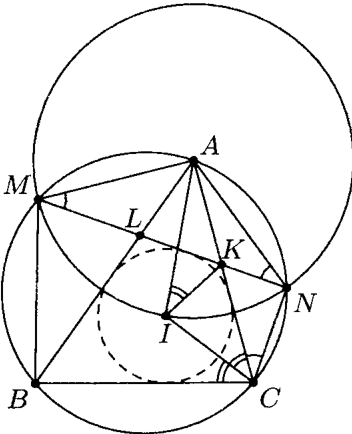
Let ∠BAC=2α, ∠ABC=2β, ∠BCA=2γ. Since AM=AN, we obtain ∠AMN=∠ANM. We have ∠AMN=∠ACN and ∠MNC=∠MAC (as inscribed angles). Further,
∠AKN=∠MAK+∠AMK==∠MAC+∠AMN==∠MNC+∠ANM=∠ANC.
It follows that the triangles AKN and ANC are similar. Similarly, the triangles ALM and AMB are similar. Then ACAN=ANAK, so AI2=AN2=AK⋅AC.
In the same manner we see that AI2=AL⋅AB, so AK⋅AC=AL⋅AB, which shows that L, K, C, B are concyclic. Then ∠AKL=∠ABC=2β. Moreover, since AI:AK=AC:AI, it follows that the triangles AIK and ACI are similar. Then ∠AIK=∠ICA=0.5∠BCA=γ. Since ∠IKC=∠IAK+∠AIK=α+γ, we have
∠IKL=180∘−∠AKL−∠IKC=180∘−2β−α−γ==180∘−2(α+β+γ)+α+γ=[α+β+γ=90∘]=α+γ=∠IKC.
Similarly, ∠KLI=∠ILB. Therefore, all bisectors of the quadrilateral LBCK intersect at the same point I. Hence LBCK is a circumscribed quadrilateral. Thus MN touches the inscribed circle of the triangle ABC.