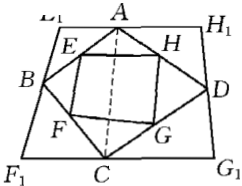
Let EFGH, ADC and E1F1G1H1 be three convex quadrilaterals, satisfying: (a) Points E, F, G and H lie on sides AB, BC, CD and DA, respectively, and EBAE⋅FCBF⋅GDCG⋅HADH=1; (b) points A, B, C and D lie on sides H1E1, E1F1, F1G1 and G1H1, respectively, and E1F1∥EF, F1G1∥FG, G1H1∥GH, H1E1∥HE. Suppose AH1E1A=λ, find the expression of CG1F1C in terms of λ. (posed by Xiong Bin)
Solution
(1) If EF∥AC, then EABE=FCBF. So HADH=GCDG using condition (a). Then HG∥AC, giving E1F1∥AC∥H1G1. That means CG1F1C=AH1E1A=λ.
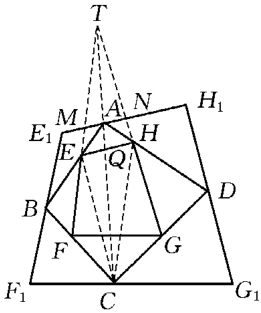
(2) If EF is not parallel to AC, extend lines EF and AC to meet at point T. By Menelaus' Theorem, we have FBCF⋅EABE⋅TCAT=1, and then GDCG⋅HADH⋅TCAT=1 using condition (a). By the inverse of Menelaus' Theorem, we know that points T, H and G are collinear. Suppose lines TF and TG meet line E1H1 at M and N respectively. As EB1∥EF, we get E1A=EABA⋅AM. In the same way, we get H1A=AHAD⋅AN. Then H1AE1A=ANAM⋅AEAB⋅ADAH.1◯ On the other hand, ANAM=QHEQ=△AHC△AEC=△ADC△ABC⋅ABAE⋅AHAD.2◯ From ①, ② we get H1AE1A=QHEQ⋅AEAB⋅ADAH=△ADC△ABC. In the same way, CG1F1C=△ADC△ABC. So CG1F1C=AH1E1A=λ.
Want a route through all this instead of an archive? The track
puts 2,604 problems in a working order, from Junior Challenge level to the IMO shortlist.
Source: MathNet,
licensed CC-BY-4.0.
Statement reproduced verbatim; metadata (topic, difficulty) added by this project.