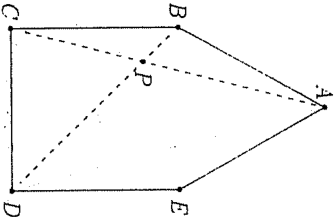
Let ABCDE be a convex pentagon with five equal sides and right angles at C and D. Let P denote the intersection point of the diagonals AC and BD. Prove that the segments PA and PD have the same length.
Solution
BCDE is a square since BC=CD=DE and BC⊥CD, CD⊥DE. Hence also the length of the segment BE coincides with the side length of the pentagon ABCDE and we have BC⊥BE and BE⊥DE. Furthermore AB=AE=BE, hence ABE is an equilateral triangle. Now we have ∠CBA=∠CBEB+∠EBA=90∘+60∘=150∘, ∠AED=∠AEB+∠BED=60∘+90∘=150∘. Since AB=BC=DE=EA the isosceles triangles ABC and AED are congruent. We get ∠BAC=∠ACB=∠DAE=∠EDA=2180∘−150∘=15∘. Since every diagonal in a square bisects the right angles in its endpoints, we have ∠ADP=∠EDB−∠EDA=45∘−15∘=30∘. ∠PAD=∠BAE−∠BAC−∠DAE=60∘−2⋅15∘=30∘. Hence ADP is a isosceles triangle with basis AD and it follows that PA=PD.
Want a route through all this instead of an archive? The track
puts 2,604 problems in a working order, from Junior Challenge level to the IMO shortlist.
Source: MathNet,
licensed CC-BY-4.0.
Statement reproduced verbatim; metadata (topic, difficulty) added by this project.