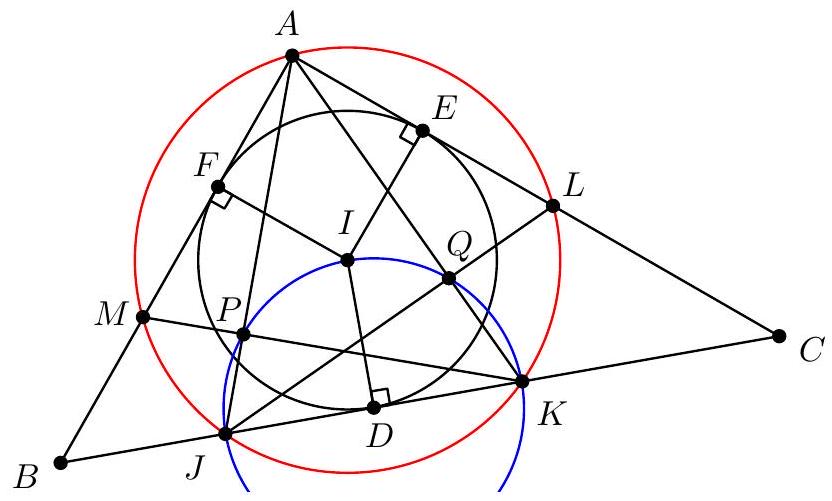
Let △ABC be an acute triangle, with A>B≥C. Let D, E and F be the tangency points between the incircle of the triangle and sides BC, CA, AB, respectively. Let J be a point on (BD), K a point on (DC), L a point on (EC) and M a point on (FB), such that AF=FM=JD=DK=LE=EA Let P be the intersection point between AJ and KM and let Q be the intersection point between AK and JL. Prove that PJKQ is cyclic.
Solution
Let I be the incenter of triangle ABC. Because ID=IE=IF, AF=FM=JD=DK=LE=EA, and the angles at D, E, and F are right, we have by Pythagoras IA=IM=IJ=IK=IL. Therefore, the pentagon AMJKL is cyclic.
On the other hand, AM=2AF=2EA=LA. We deduce for the circumcircle of the pentagon AMJKL that AM = LA. This implies that ∡QKP=∡QJP, and therefore the quadrilateral PJKQ is cyclic.
Want a route through all this instead of an archive? The track
puts 2,604 problems in a working order, from Junior Challenge level to the IMO shortlist.
Source: MathNet,
licensed CC-BY-4.0.
Statement reproduced verbatim; metadata (topic, difficulty) added by this project.