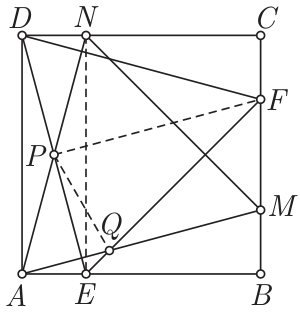
Let ABCD be a square. We take the points E∈(AB), N∈(CD) and F,M∈(BC), such that the triangles AMN and DEF are equilateral. Prove that PQ=FM, where {P}=AN∩DE and {Q}=AM∩EF.
Solution
Because △ABM≡△ADN and △DAE≡△DCF, we have m(BAM)=m(DAN)=m(ADE)=m(CDF)=15∘. Then △ ABM ≡△ ADN ≡△ DAE ≡△ DCF and △AMN≡△DEF. It is clear now that ADNE is a rectangle, and thus P is the common midpoint of the line segments [AN] and [DE]. Then, in the equilateral triangle DEF we have PF⊥DE. As m(DAM)+m(ADE)=m(DAM)+m(BAM)=90∘, we get that AM⊥DE, obtaining that AM∥PF. The equality m(PAQ)=m(PEQ)=60∘ implies that PAEQ is a cyclic quadrilateral, and thus m(FPQ)=m(EPF)−m(EPQ)=75∘. On the other hand, m(MFP)=180∘−m(CFD)−m(DFP)=75∘, which implies that MQPF is an isosceles trapezoid and thus [PQ]=[FM].
Want a route through all this instead of an archive? The track
puts 2,604 problems in a working order, from Junior Challenge level to the IMO shortlist.
Source: MathNet,
licensed CC-BY-4.0.
Statement reproduced verbatim; metadata (topic, difficulty) added by this project.