Around each vertex of a regular hexagon of side length in a plane, one draws a circle of radius with centre at that vertex and paints the region inside the circle blue. Find the area of the part of the plane that is painted blue.
National Olympiad Final Round
Solution
The circles drawn around two neighbouring vertices of the hexagon intersect, since . Hence every two neighbouring circles have a common region of the shape of a lens. Since a regular hexagon can be put together from six equilateral triangles, the circumradius of the hexagon equals . The altitude of one equilateral triangle is .
The distance between a vertex and the second one counting from that vertex along the circumference is , since it equals twice the altitude of the equilateral triangle (Fig. 17). As , circles drawn around such two vertices do not intersect. Thus the circles drawn around opposite vertices do not intersect either.
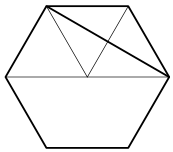
Fig. 17
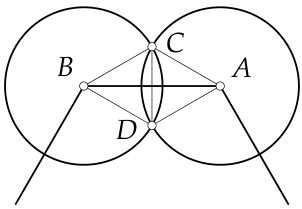
Fig. 18
, i.e., , whence , implying that the triangle is equilateral. Thus the area of sector and triangle equal and , respectively. The area of the region painted blue is , which equals .
Want a route through all this instead of an archive? The track
puts 2,604 problems in a working order, from Junior Challenge level to the IMO shortlist.