The bisector of the internal angle at the vertex of a triangle intersects the circumcircle of the triangle at a point (). The line through perpendicular to the line intersects the circumcircle of the triangle at a point (). Prove that the quadrilateral is a square if and only if .
Estonian Math Competitions
Solutions — 2
Solution 1
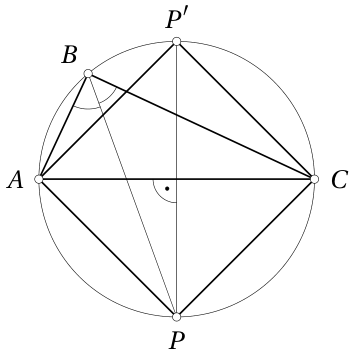
As (see figure), it suffices to show that the quadrilateral is a square if and only if .
Since , we have . Thus is the perpendicular bisector of the side . Hence the line passes through the circumcentre of the triangle , i.e., the chord is a diameter. By Thales' theorem, .
If then also . Thus the quadrilateral is a rectangle and, by equality of adjacent sides and , a square. On the other hand, if is a square then obviously . This completes the proof.
Solution 2
Since , it suffices to show that the quadrilateral is a square if and only if .
As , we have . Thus bisects the line segment .
If then, by Thales' theorem, is the diameter of the circumcircle of the triangle . Thus the chord bisecting passes through the circumcentre of the triangle , implying that bisects the chord . As , the diagonals of the quadrilateral are perpendicular and bisect each other. Hence the quadrilateral is a rhombus and, because of , a square. On the other hand, if is a square then obviously . This completes the proof.
Want a route through all this instead of an archive? The track
puts 2,604 problems in a working order, from Junior Challenge level to the IMO shortlist.