Maths Olympiad Prep

Library / /38 of 82

Geometry Difficulty 5.5 AIME, harder Prove it Croatia

Let ABCDABCD be a convex quadrilateral such that BAD=90\angle BAD = 90^\circ, BAC=2BDC\angle BAC = 2\angle BDC and DBA+DCB=180\angle DBA + \angle DCB = 180^\circ. Find DBA\angle DBA.

Solution

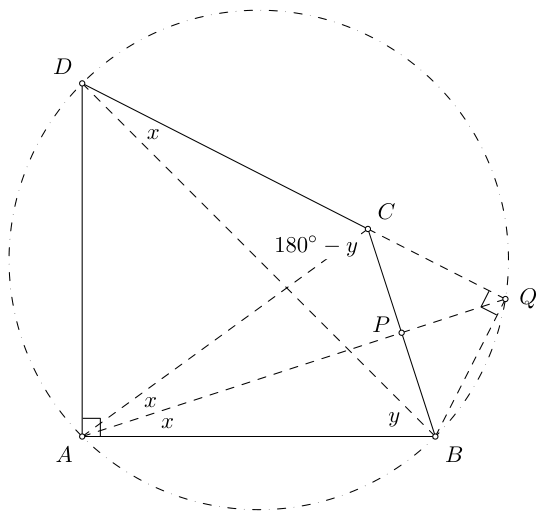
Denote BDC=x\angle BDC = x and DBA=y\angle DBA = y. Then BAC=2x\angle BAC = 2x. Let PP and QQ be the intersections of the angle bisector of BAC\angle BAC with segment BC\overline{BC} and ray DCDC.

Figure 1

Since BAQ=BDQ=x\angle BAQ = \angle BDQ = x, the quadrilateral ABQDABQD is cyclic. Given that BAD\angle BAD is a right angle, DQB\angle DQB is a right angle as well.

Inscribed angles DQA\angle DQA and DBA\angle DBA subtending the AD\overline{AD} are equal, i.e. DQA=y\angle DQA = y, while AQB=90y\angle AQB = 90^\circ - y.

From BCQ=180DCB=y=DQA\angle BCQ = 180^\circ - \angle DCB = y = \angle DQA, we see that the triangle PQCPQC is isosceles and that PQ=PC|PQ| = |PC|.

Since QBP=QPCPQB=1802y(90y)=90y=AQB\angle QBP = \angle QPC - \angle PQB = 180^\circ - 2y - (90^\circ - y) = 90^\circ - y = \angle AQB, triangle PBQPBQ is isosceles as well and PB=PQ|PB| = |PQ|.

Hence, PP is the midpoint of BC\overline{BC} and, by the converse of the angle bisector theorem applied to BAC\angle BAC, we conclude that AB=AC|AB| = |AC|. Therefore 90=APB=QPC=1802y90^\circ = \angle APB = \angle QPC = 180^\circ - 2y, which implies that DBA=y=45\angle DBA = y = 45^\circ.

Want a route through all this instead of an archive? The track puts 2,000 problems in a working order, from AMC 10 level to the IMO shortlist.

Source: MathNet, licensed CC-BY-4.0. Statement and solution reproduced as published; topic and difficulty added by this site.