Maths Olympiad Prep

Track / Stage 2 / 252 of 320 #572 of 2604

Problem 572

Geometry Difficulty 2.7 Multiple choice CEMC Pascal · Canada · 2025

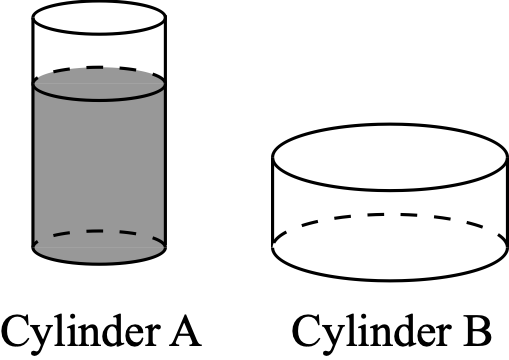
Two cylinders are standing on a flat table. Cylinder A has radius
22 and height 88. Cylinder B has radius 88 and height 22. Cylinder A is 34\frac{3}{4} full of water and Cylinder B is empty.Figure 0If all of the water from Cylinder A is then poured into Cylinder B, what fraction of Cylinder B is full of water? (The volume of a cylinder with radius rr and height hh is πr2h\pi r^2h.)

Pick one

Next problem →

Official solution

Solution 1:

The volume of Cylinder A is π×22×8=32π\pi\times2^2\times8=32\pi, and so the volume of water in Cylinder A is 34×32π=24π\frac34\times32\pi=24\pi. If all of the water from Cylinder A is poured into Cylinder B, the volume of water in Cylinder B is 24π24\pi. The volume of Cylinder B is π×82×2=128π\pi\times8^2\times2=128\pi, and so the fraction of Cylinder B that is full of water is 24π128π=316\dfrac{24\pi}{128\pi}=\dfrac{3}{16}. Solution 2: As in Solution 1, the volume of water in Cylinder B would be 24π24\pi. Suppose that the height of the water in Cylinder B is hh. Then, π×82×h=24π\pi\times8^2\times h=24\pi or h=24π64π=38h=\dfrac{24\pi}{64\pi}=\dfrac{3}{8}. Since the height of Cylinder B is 22 and the height of the water is 38\dfrac38, then the fraction of Cylinder B that is full of water is 3/82=316\dfrac{3/8}{2}=\dfrac{3}{16}.

Figure for this problem

Source: CEMC, University of Waterloo, licensed CC-BY-NC-4.0. Statement reproduced verbatim; metadata (topic, difficulty, ordering) added by this project.