Maths Olympiad Prep

Track / Stage 3 / 141 of 260 #781 of 2604

Problem 781

AMC 10/12, early questions
Geometry Difficulty 3.6 Find the answer CEMC Fermat · Canada · 2020

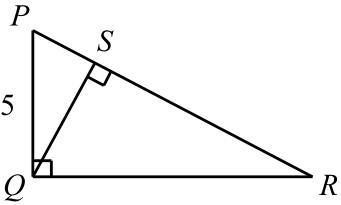
In the diagram, PQR\triangle PQR is right-angled at QQ and point SS is on PRPR so that QSQS is perpendicular to PRPR.Figure 0If the area of PQR\triangle PQR is 30 and PQ=5PQ=5, the length of QSQS is 6013\frac{60}{13} 55 3013\frac{30}{13} 44 33

A number or a short expression. Fractions can be typed as 3/2, and spacing doesn't matter.

Next problem →

Official solution

Since PQR\triangle PQR is right-angled at QQ, its area equals 12PQQR\frac{1}{2}\cdot PQ \cdot QR. Since its area is 30 and PQ=5PQ=5, then 125QR=30\frac{1}{2} \cdot 5 \cdot QR = 30 and so QR=3025=12QR = 30 \cdot \frac{2}{5} = 12. By the Pythagorean Theorem, we know that PR2=PQ2+QR2=52+122=25+144=169PR^2 = PQ^2 + QR^2 = 5^2 + 12^2 = 25+144 = 169 Since PR>0PR>0, then PR=169=13PR = \sqrt{169} = 13. If we now consider PQR\triangle PQR as having base PRPR and perpendicular height QSQS, we see that its area equals 12PRQS\frac{1}{2} \cdot PR \cdot QS. Since its area is 30 and PR=13PR = 13, then 1213QS=30\frac{1}{2} \cdot 13 \cdot QS = 30 which gives QS=30213=6013QS = 30 \cdot \frac{2}{13} = \frac{60}{13}.

Figure for this problem

Source: CEMC, University of Waterloo, licensed CC-BY-NC-4.0. Statement reproduced verbatim; metadata (topic, difficulty, ordering) added by this project.