Of the five answers shown, which is the largest amount of postage you cannot make using only 5¢ and 8¢ stamps?
Problem 606
Pick one
Official solution
Solution 1
Since and , then we might guess that the three consecutive odd numbers whose product is 9177 are closer to 20 than they are to 30.
Using trial and error, we determine that , which is too large.
The next smallest set of three consecutive odd numbers is and the product of these three numbers is , as required.
Thus, the sum of the three consecutive odd numbers whose product is 9177 is .
Solution 2
We begin by determining the prime numbers whose product is 9177.
(This is called the prime factorization of 9177.)
This prime factorization of 9177 is shown in the following factor tree.
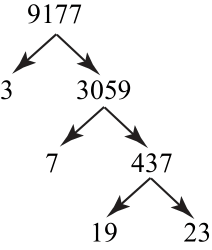
That is, . Since , then and so the three consecutive numbers whose product is 9177 are .
Thus, the sum of the three consecutive odd numbers whose product is 9177 is .