Alice is drawing a shape on a piece of paper. She starts by placing her pencil at the origin, and then draws line segments of length , alternating between vertical and horizontal segments. Eventually, her pencil returns to the origin, forming a closed, non-self-intersecting shape. Show that the area of this shape is even if and only if its perimeter is a multiple of eight.
Problem 2416
Official solutions — 3
Solution 1
Colour the horizontal segments in every other line of the grid alternately red and blue as shown below:
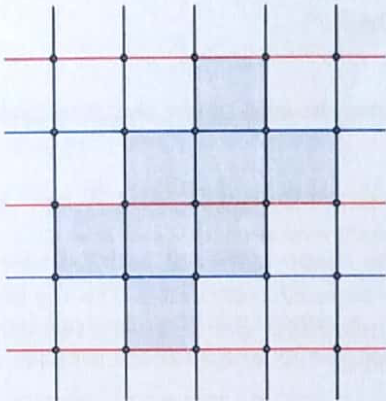
Let there be red segments on the perimeter and red segments in the interior of the shape. By considering the possibilities starting from a red segment, we see that every fourth segment on the perimeter of the shape will be red, therefore we have . Also, every square has exactly one red edge, thus . So from which the result follows.
Solution 2
Colour the square in the grid with a chessboard colouring. The alternation of vertical and horizontal segments means that all squares with an edge on the perimeter and lying within the shape are of the same colour, say black.
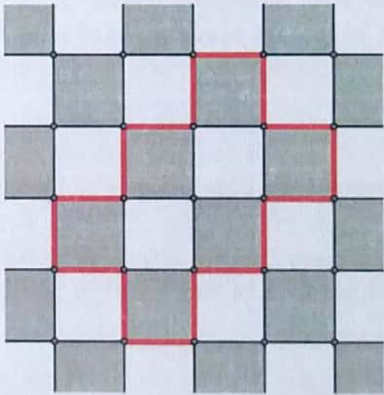
Any internal edge within the shape lies between a white and black square, so if the number of white squares within the shape is , the number of edges of the chessboard lying inside the shape is . If the total number of squares in the shape is , then counts every edge on the perimeter once, and every internal edge twice, so the perimeter has length , which is a multiple of if and only if is even.
Solution 3
We have as many horizontal perimeter edges as vertical, so it is enough to show that the area is even if and only if the number of vertical perimeter edges is a multiple of . In each horizontal strip of height , pair the vertical perimeter edges in order from left to right. (We can do so because there must be an even number of vertical perimeter edges in every such strip.) Let us assume that we have such pairs. So we need to show that the area is even if and only if is even.
As in Solution 2, every such pair of perimeter edges encloses a consecutive set of squares of the shape with the first and last of these squares being, without loss of generality, black. So each such pair accounts for an odd number of squares inside the shape and therefore the area is even if and only if is even as required.
By Green's Theorem the area of the shape is equal to
where is the boundary of the shape traversed anticlockwise. We partition into its line segments of length . Each line segment contributes to the integral if it is horizontal and to the integral if it is on the vertical line . Every two consecutive vertical line segments contribute .
So the area is even if and only if the number of vertical line segments is which happens if and only if the perimeter is . (Since there is an equal even number of horizontal and vertical line segments.)