Maths Olympiad Prep

Track / Stage 8 / 90 of 180 #1790 of 1964

Problem 1790

IMO Shortlist mid-range; USAMO P2/P5
Geometry Difficulty 8.3 Prove it China National Team Selection Test · China

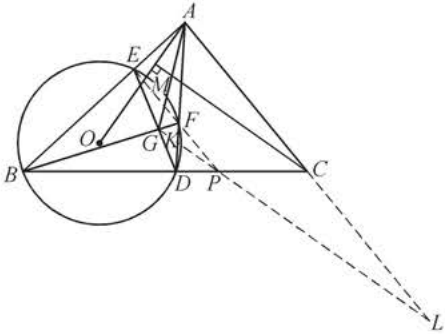
Let DD be a point on side BCBC of triangle ABCABC such that CAD=CBA\angle CAD = \angle CBA. A circle with center OO passes through BB, DD, and meets segments ABAB, ADAD at EE, FF, respectively. Lines BFBF and DEDE meet at point GG. MM is the midpoint of AGAG. Prove that CMAOCM \perp AO. (Posed by Xiong Bin)

This one wants a proof. Work it on paper, then read the official solution and mark yourself. Be honest about it: the record is only any use to you if it is.

Official solution

As shown in Fig. 1, extend EFEF and meet BCBC at point PP, and join and extend GPGP, which meets ADAD at KK and the extension of ACAC at LL.

Figure 1
Fig. 1

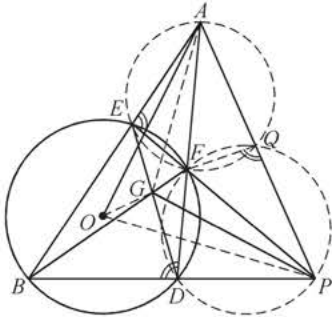
As shown in Fig. 2, let QQ be a point on APAP such that
PQF=AEF=ADB. \angle PQF = \angle AEF = \angle ADB.
It is easy to see that A,E,F,QA, E, F, Q and F,D,P,QF, D, P, Q are concyclic respectively. Denote by rr the radius of O\odot O. By the power of a point theorem,
AP2=AQ×AP+PQ×AP=AF×AD+PF×PE=(AO2r2)+(PO2r2). \begin{aligned} AP^2 &= AQ \times AP + PQ \times AP \\ &= AF \times AD + PF \times PE \\ &= (AO^2 - r^2) + (PO^2 - r^2). \end{aligned}

Similarly,
AG2=(AO2r2)+(GO2r2). AG^2 = (AO^2 - r^2) + (GO^2 - r^2).

By ①, ②, we have AP2AG2=PO2GO2AP^2 - AG^2 = PO^2 - GO^2, which implies that PGAOPG \perp AO.

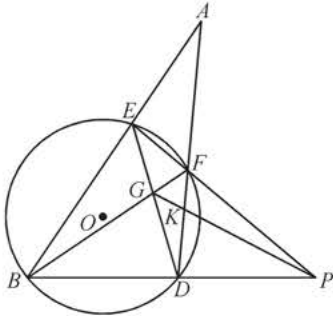
As shown in Fig. 3, applying Menelaus' theorem for PFD\triangle PFD and line AEBAEB, we have

Figure 2
Fig. 2

DAAF×FEEP×PBBD=1.3 \frac{DA}{AF} \times \frac{FE}{EP} \times \frac{PB}{BD} = 1. \quad \textcircled{3}

Applying Ceva's theorem for PFD\triangle PFD and point GG, we have
DKKF×FEEP×PBBD=1.4 \frac{DK}{KF} \times \frac{FE}{EP} \times \frac{PB}{BD} = 1. \quad \textcircled{4}

÷\div ④ yields
DAAF=DKKF.5 \frac{DA}{AF} = \frac{DK}{KF}. \quad \textcircled{5}

Figure 3
Fig. 3

Equation ⑤ illustrates that A,KA, K are harmonic points with respect to F,DF, D, i.e. AF×KD=AD×FKAF \times KD = AD \times FK.

It follows that
AK×FD=AF×KD+AD×FK=2AF×KD.6 AK \times FD = AF \times KD + AD \times FK = 2AF \times KD. \quad \textcircled{6}

Since B,D,F,EB, D, F, E are concyclic, we have DBA=EFA\angle DBA = \angle EFA. Since CAD=CBA\angle CAD = \angle CBA, we have CAF=EFA\angle CAF = \angle EFA, which implies that ACEPAC \parallel EP. Thus,
CPPD=AFFD.7 \frac{CP}{PD} = \frac{AF}{FD}. \quad \textcircled{7}

Applying Menelaus' theorem to ACD\triangle ACD and line LPKLPK, we have
ALLC×CPPD×DKKA=1.8 \frac{AL}{LC} \times \frac{CP}{PD} \times \frac{DK}{KA} = 1. \quad \textcircled{8}

Combining ⑥, ⑦ and ⑧, we have ALLC=2\frac{AL}{LC} = 2.

In AGL\triangle AGL, M,CM, C are the midpoints of AG,ALAG, AL respectively, and hence MCGLMC \parallel GL. Since GLAOGL \perp AO, we conclude that MCAOMC \perp AO.

Source: MathNet, licensed CC-BY-4.0. Statement and solution reproduced as published; topic, difficulty and ordering added by this site.