Olympiad Maths Prep

Track / Stage 10 / 23 of 40 #1983 of 2000

Problem 1983

Hardest shortlist tier
Geometry Difficulty 9.3 Prove it 49th International Mathematical Olympiad Spain · IMO

In the plane we consider rectangles whose sides are parallel to the coordinate axes and have positive length. Such a rectangle will be called a box. Two boxes intersect if they have a common point in their interior or on their boundary.
Find the largest nn for which there exist nn boxes B1,,BnB_{1}, \ldots, B_{n} such that BiB_{i} and BjB_{j} intersect if and only if i≢j±1(modn)i \not \equiv j \pm 1(\bmod n).

This one wants a proof. Work it on paper, read the official solution, then mark yourself honestly — the ladder only means something if the record is true.

Official solution

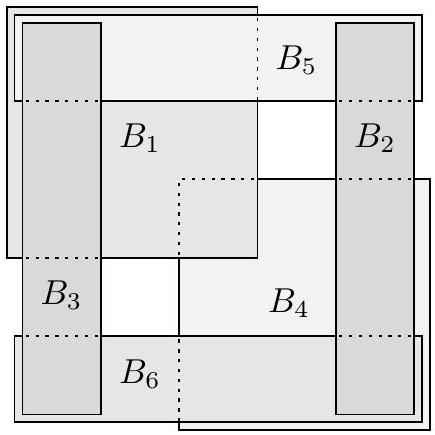
The maximum number of such boxes is 66. One example is shown in the figure.

Figure 1

Now we show that 66 is the maximum. Suppose that boxes B1,,BnB_{1}, \ldots, B_{n} satisfy the condition. Let the closed intervals IkI_{k} and JkJ_{k} be the projections of BkB_{k} onto the xx- and yy-axis, for 1kn1 \leq k \leq n.

If BiB_{i} and BjB_{j} intersect, with a common point (x,y)(x, y), then xIiIjx \in I_{i} \cap I_{j} and yJiJjy \in J_{i} \cap J_{j}. So the intersections IiIjI_{i} \cap I_{j} and JiJjJ_{i} \cap J_{j} are nonempty. Conversely, if xIiIjx \in I_{i} \cap I_{j} and yJiJjy \in J_{i} \cap J_{j} for some real numbers x,yx, y, then (x,y)(x, y) is a common point of BiB_{i} and BjB_{j}. Putting it around, BiB_{i} and BjB_{j} are disjoint if and only if their projections on at least one coordinate axis are disjoint.

For brevity we call two boxes or intervals adjacent if their indices differ by 11 modulo nn, and nonadjacent otherwise.

The adjacent boxes BkB_{k} and Bk+1B_{k+1} do not intersect for each k=1,,nk=1, \ldots, n. Hence (Ik,Ik+1)(I_{k}, I_{k+1}) or (Jk,Jk+1)(J_{k}, J_{k+1}) is a pair of disjoint intervals, 1kn1 \leq k \leq n. So there are at least nn pairs of disjoint intervals among (I1,I2),,(In1,In),(In,I1);(J1,J2),,(Jn1,Jn),(Jn,J1)\left(I_{1}, I_{2}\right), \ldots,\left(I_{n-1}, I_{n}\right),\left(I_{n}, I_{1}\right);\left(J_{1}, J_{2}\right), \ldots,\left(J_{n-1}, J_{n}\right),\left(J_{n}, J_{1}\right).

Next, every two nonadjacent boxes intersect, hence their projections on both axes intersect, too. Then the claim below shows that at most 33 pairs among (I1,I2),,(In1,In),(In,I1)\left(I_{1}, I_{2}\right), \ldots,\left(I_{n-1}, I_{n}\right),\left(I_{n}, I_{1}\right) are disjoint, and the same holds for (J1,J2),,(Jn1,Jn),(Jn,J1)\left(J_{1}, J_{2}\right), \ldots,\left(J_{n-1}, J_{n}\right),\left(J_{n}, J_{1}\right). Consequently n3+3=6n \leq 3+3=6, as stated. Thus we are left with the claim and its justification.

Claim. Let Δ1,Δ2,,Δn\Delta_{1}, \Delta_{2}, \ldots, \Delta_{n} be intervals on a straight line such that every two nonadjacent intervals intersect. Then Δk\Delta_{k} and Δk+1\Delta_{k+1} are disjoint for at most three values of k=1,,nk=1, \ldots, n.

Proof. Denote Δk=[ak,bk],1kn\Delta_{k}=[a_{k}, b_{k}], 1 \leq k \leq n. Let α=max(a1,,an)\alpha=\max \left(a_{1}, \ldots, a_{n}\right) be the rightmost among the left endpoints of Δ1,,Δn\Delta_{1}, \ldots, \Delta_{n}, and let β=min(b1,,bn)\beta=\min \left(b_{1}, \ldots, b_{n}\right) be the leftmost among their right endpoints. Assume that α=a2\alpha=a_{2} without loss of generality.

If αβ\alpha \leq \beta then aiαβbia_{i} \leq \alpha \leq \beta \leq b_{i} for all ii. Every Δi\Delta_{i} contains α\alpha, and thus no disjoint pair (Δi,Δi+1)(\Delta_{i}, \Delta_{i+1}) exists.

If β<α\beta<\alpha then β=bi\beta=b_{i} for some ii such that ai<bi=β<α=a2<b2a_{i}<b_{i}=\beta<\alpha=a_{2}<b_{2}, hence Δ2\Delta_{2} and Δi\Delta_{i} are disjoint. Now Δ2\Delta_{2} intersects all remaining intervals except possibly Δ1\Delta_{1} and Δ3\Delta_{3}, so Δ2\Delta_{2} and Δi\Delta_{i} can be disjoint only if i=1i=1 or i=3i=3. Suppose by symmetry that i=3i=3; then β=b3\beta=b_{3}. Since each of the intervals Δ4,,Δn\Delta_{4}, \ldots, \Delta_{n} intersects Δ2\Delta_{2}, we have aiαbia_{i} \leq \alpha \leq b_{i} for i=4,,ni=4, \ldots, n. Therefore αΔ4Δn\alpha \in \Delta_{4} \cap \ldots \cap \Delta_{n}, in particular Δ4Δn\Delta_{4} \cap \ldots \cap \Delta_{n} \neq \emptyset. Similarly, Δ5,,Δn,Δ1\Delta_{5}, \ldots, \Delta_{n}, \Delta_{1} all intersect Δ3\Delta_{3}, so that Δ5ΔnΔ1\Delta_{5} \cap \ldots \cap \Delta_{n} \cap \Delta_{1} \neq \emptyset as βΔ5ΔnΔ1\beta \in \Delta_{5} \cap \ldots \cap \Delta_{n} \cap \Delta_{1}. This leaves (Δ1,Δ2)(\Delta_{1}, \Delta_{2}), (Δ2,Δ3)(\Delta_{2}, \Delta_{3}) and (Δ3,Δ4)\left(\Delta_{3}, \Delta_{4}\right) as the only candidates for disjoint interval pairs, as desired.

Source: MathNet, licensed CC-BY-4.0. Statement and solution reproduced as published; topic, difficulty and ordering added by this site.