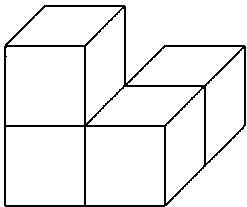
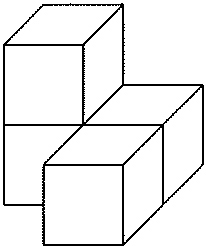
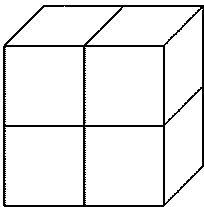
As shown in the following figure, there are four types of blocks formed by four cubes of side one. How many ways are there for putting four blocks of these types in a rectangular box so that they do not stick out?
Note that we can use multiple blocks of the same type, and blocks can be rotated. Additionally, we distinguish ways which coincide with each other by rotating the box.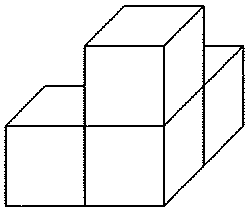
Problem 1679
Official solution
Denote a cube of side one as a small cube. The rectangular box consists of small cubes, and we denote a cube of side two (formed by eight small cubes) in the box as a medium cube.
Consider the case where there are four blocks in the box. For each block in the box, there exists a medium cube containing that block. We choose one such medium cube and call it circumscribed medium cube of the block. There are four circumscribed medium cubes, but the rectangular box contains only three medium cubes. By the pigeonhole principle, there exist two blocks with common circumscribed medium cubes. Since the sum of the volumes of the two blocks is equal to the volume of a medium cube, these two blocks form a medium cube.
Now, we calculate the number of cases to combine two blocks to form a medium cube. First, we distinguish the order of these two blocks. As shown in the figure below, we denote four types of blocks as (a), (b), (c), and (d), respectively. Note that when the position of the first block is given, the shape and orientation of the second block are uniquely determined if there exists such a second block that forms a medium cube with the first.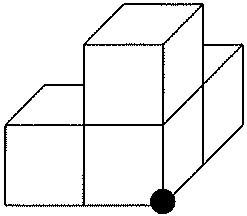
(a)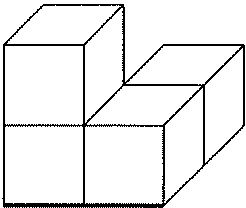
(b)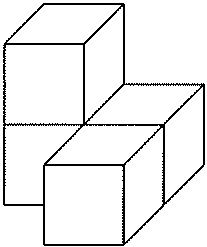
(c)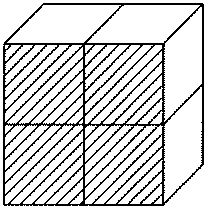
(d)
* In the case where the first block is (a), there is a one-to-one correspondence between the position of the first block and the location of the vertex of the medium cube where the black dot in the figure coincides with it. Then we can combine another (a) to form a medium cube. Since there are eight vertices in the cube, there are eight combinations.
* In the case where the first block is (b), there is a one-to-one correspondence between the position of the first block and the location of the edge of the medium cube where the bold line in the figure coincides with it. Then we can combine another (b) to form a medium cube. Since there are twelve edges in the cube, there are twelve combinations.
* In the case where the first block is (c), the same argument as (b) holds from symmetry. Thus there are twelve combinations.
* In the case where the first block is (d), there is a one-to-one correspondence between the position of the first block and the location of the face of the medium cube where the shaded area in the figure coincides with it. Then we can combine another (d) to form a medium cube. Since there are six faces in the cube, there are six combinations.
Therefore, there are a total of combinations, and counting without distinguishing the first and second block yields combinations.
Finally, we consider the position of the medium cube formed by two blocks in the box. Denote the two faces of the box as upper face and lower face, respectively. Among three medium cubes, let A be the one containing the upper face, B containing the lower face, and C containing neither. If A is formed by two blocks, B is also formed by two blocks, and vice versa. Thus,
In the case where A* and B are formed by two blocks, there are ways to put blocks.
* In the case where C is formed by two blocks, the remaining two blocks are both (d). Hence there are ways to put blocks.
* In the case where A, B, and C are all formed by two blocks, all four blocks are (d) and put in the box so that the faces are parallel to the top face, thus there is only one way to put blocks.
Therefore, the answer is .