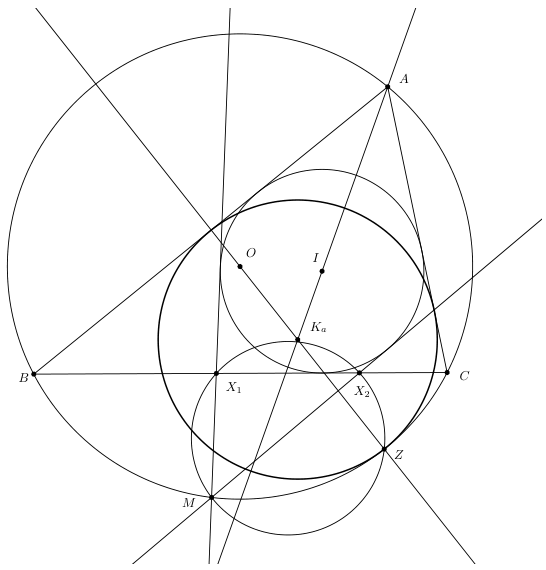
Let point M be a point on the circumcircle of triangle ABC. From point M draw the (two) lines tangent to the incircle of triangle ABC, meeting BC at points X1,X2 respectively. Prove that the second intersection point (i.e., the intersection point different from M) of the circumcircle of triangle MX1X2 with the circumcircle of ABC is exactly the tangency point of the circumcircle of ABC with the mixtilinear incircle in angle A. (Note: the mixtilinear incircle in angle A refers to the circle that is tangent to both sides AB,AC, and is internally tangent to the circumcircle of ABC.)
Let M be an arbitrary point on the circumcircle of triangle ABC and let the tangents from this point to the incircle of the triangle meet the sideline BC at X1, and X2. Prove that the second intersection of the circumcircle of triangle MX1X2 with the circumcircle of ABC (different from M) coincides with the tangency point of the circumcircle with mixtilinear incircle in angle A. (As usual, the A-mixtilinear incircle names the circle tangent to AB,AC and to the circumcircle of ABC internally.)
This one wants a proof. Work it on paper, then read the official solution and mark yourself. Be honest about it: the record is only any use to you if it is.
End of the track
Official solution
Assume without loss of generality that M lies on the same side of line BC as the vertex A. In this case, we denote by (I) the common incircle of triangles ABC, and MX1X2 with radius r, and let D,E,F,Y1,Y2 be the tangency points of (I) with the sidelines BC,CA,AB,MX1,MX2.
Consider the inversion Ψ with center I and power r2, which takes the vertices A,B,C,M,X1,X2 to the midpoints A′,B′,C′,M′,X1′,X2′ of the sides EF,FD,DE,Y2Y1,Y1D,DY2 of the intouch triangles DEF, and DY2Y1. The circumcircles (O),(P) of triangles ABC, and MX1X2 become the circumcircles (O′),(P′) of the triangles A′B′C′,M′X1′X2′, which, because they coincide with the nine-point circles of two triangles of the same circumcircle, are congruent and have the common radius 2r. Since the sidelines BC,CA,AB,MX1,MX2 are tangent to the inversion circle (I), their images under Ψ are the congruent circles Γa,Γb,Γc,Ω1,Ω2 with diameters ID,IE,IF,IX1,IX2, respectively. The congruent circles (O′),Γb,Γc
with radii 2r meet at point A′. Thus, a circle (A′,r) with center A′ and radius r is tangent to all three at points diametrically opposite to A′.
The internal angle-bisector AI of the angle ∠A passing through the inversion center I is carried into itself. The mixtilinear incircle (Ka) and the mixtilinear excircle (La) of the triangle ABC in the angle A are the only two circles centered on AI and simultaneously tangent to CA,AB, and (O). Since the inversion center I is the similarity center of a circle and its inversion images, only the images (Ka′),(La′) of (Ka),(La) are centered on AI and tangent to Γb,Γc,(O′). The mixtilinear excircle (La), lying outside of the circumcircle (O) and outside of the inversion circle (I), has both intersections with AI on the ray ILa. Since the inversion in (I) has positive power r2, its images (La′) also has both intersections with AI on the ray ILa and it is centered on the ray IA. It cannot be identical with the circle (A′,r) centered on the opposite ray IA. Therefore, the image of the mixtilinear incircle (Ka) in angle A under Ψ is the circle (A′,r). Furthermore, the inverse image of the tangency point Z of the circles (Ka), and (O) is the tangency point Z′ of (A′,r) and (O), the antipode of A′ with respect to the circumcircle (O′).
Let now A0,B0,C0,O1,O2 be the centers of the congruent circles Γa,Γb,Γc,Ω1,Ω2. Since Γa is the reflection of (O′) in B′C′ and since O′ and I are isogonal conjugated with respect to triangle A′B′C′, the quadrilateral B′Z′C′I is a parallelogram, and therefore, its diagonals B′C′,IZ′ cut each other at half at the midpoint of segment B′C′. It now follows that the quadrilateral IA0Z′O′ is also a parallelogram, and thus, IA0=O′Z′=2r. Now since A0I=A0X1′=O1I=O1X1′=2r, the quadrilateral A0IO1X1′ is a rhombus, and since the segments O1X1′,IA0,O′Z′ are parallel and congruent, the quadrilateral O1X1′Z′O′ is a parallelogram. In conclusion, the triangles PX1′Z′, and M′O1O′ are congruent and P′Z′=M′O′=2r. Hence, Z′ lies on the circle (P′), which means that the second intersection of the circumcircle (P) of triangle MX1X2 with the circumcircle (O) of ABC (different from M) coincides with the tangency point Z of the mixtilinear incircle in angle A with the circumcircle (O).
Source: MathNet,
licensed CC-BY-4.0.
Statement translated into English from zh; metadata (topic, difficulty, ordering) added by this project.