Three friends are in the park. Bob and Clarise are standing at the same spot and Abe is standing 10 m away. Bob chooses a random direction and walks in this direction until he is 10 m from Clarise. What is the probability that Bob is closer to Abe than Clarise is to Abe?
CEMC Cayley, 2014
Pick one
Solution
We call Clarise’s spot and Abe’s spot .
Consider a circle centred at with radius 10 m. Since is 10 m from , then is on this circle.
Bob starts at and picks a direction to walk, with every direction being equally likely to be chosen. We model this by having Bob choose an angle between and and walk 10 m along a segment that makes this angle when measured counterclockwise from .
Bob ends at point , which is also on the circle.
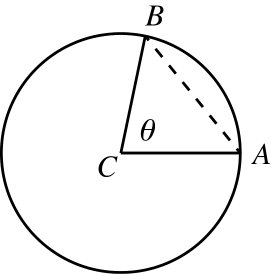
We need to determine the probability that .
Since the circle is symmetric above and below the diameter implied by , we can assume that is between and as the probability will be the same below the diameter.
Consider and note that m.
It will be true that whenever is the shortest side of .
will be the shortest side of whenever it is opposite the smallest angle of . (In any triangle, the shortest side is opposite the smallest angle and the longest side is opposite the largest angle.)
Since is isosceles with , then .
We know that is opposite and .
Since , then or .
If is smaller than , then will be greater than .
Similarly, if is greater than , then will be smaller than .
Therefore, is the shortest side of whenever is between and .
Since is uniformly chosen in the range to and , then the probability that is in the desired range is .
Therefore, the probability that Bob is closer to Abe than Clarise is to Abe is .
(Note that we can ignore the cases , and because these are only three specific cases out of an infinite number of possible values for .)
Want a route through all this instead of an archive? The track
puts 2,604 problems in a working order, from Junior Challenge level to the IMO shortlist.