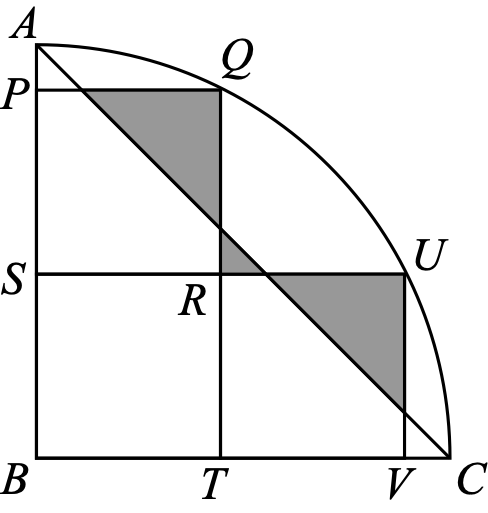
In the diagram, ABC is a quarter-circle centred at B. Each of square PQRS, square SRTB and square RUVT has side length 10. Points P and S are on AB, points T and V are on BC, and points Q and U are on the quarter-circle. Line segment AC is drawn. Three triangular regions are shaded, as shown.
What is the integer closest to the total area of the shaded regions?
A number or a short expression. Fractions can be typed as 3/2, and spacing doesn't matter.
Solution
Since AB and BC are both radii of the circle, then AB=BC.
Since ABC is a quarter-circle centred at B, then ∠ABC=90°.
Thus, △ABC is isosceles and right-angled, which means that ∠BAC=∠BCA=45°.
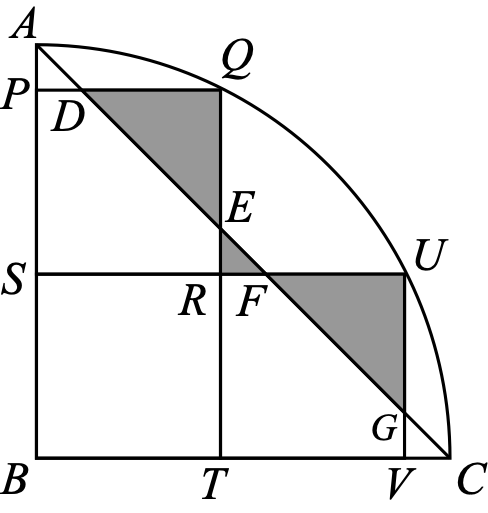
We add some additional labels to the diagram:
We note that the angles between the straight lines at P, Q, R, and U are all right angles.
Since ∠PAD=∠BAC=45°, this means that ∠PAD=∠ADP=∠QDE=∠DEQ=∠REF=∠EFR=∠UFG=∠UGF=45° This in turn means that each of △APD, △DQE, △ERF, and △FUG is right-angled and isosceles.
Since the side length of each square is 10, then BT=10 and TQ=TR+RQ=20.
Since ∠BTQ=90°, then by the Pythagorean Theorem, BQ=BT2+TQ2=102+202=500 We note that 500=100×5=100×5=105.
Since BQ is a radius of the circle, then BQ=BA=BC=105.
Since BP=TQ=20, then AP=BA−BP=105−20.
Thus, PD=AP=105−20.
Since PQ=10, then DQ=PQ−PD=10−(105−20)=30−105.
Thus, QE=DQ=30−105.
Since PQ=QR and DQ=QE, then PD=ER=105−20.
Using similar reasoning, ER=RF=105−20 and UF=UG=30−105.
The total area, A, of the shaded regions equals the sum of the areas of △DQE, △ERF and △FUG.
Therefore, Aamp;=21×DQ×QE+21×ER×RF+21UF×UGamp;=21(30−105)2+21(105−20)2+21(30−105)2amp;=(30−105)2+21(105−20)2amp;=(302−2×30×105+(105)2)+21((105)2−2×105×20+202)amp;=(900−6005+500)+21(500−4005+400)amp;=1400−6005+450−2005amp;=1850−8005amp;≈61.14 and so the integer closest to A is 61.
Want a route through all this instead of an archive? The track
puts 2,604 problems in a working order, from Junior Challenge level to the IMO shortlist.