In the diagram, square is . Points and are on side with . Points and are on side with . Line segments and are perpendicular to and line segments and are perpendicular to .
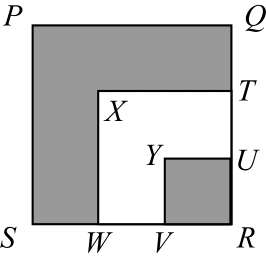
The ratio of the shaded area to the unshaded area is
In the diagram, square is . Points and are on side with . Points and are on side with . Line segments and are perpendicular to and line segments and are perpendicular to .
The ratio of the shaded area to the unshaded area is
Pick one
Solution 1
Since is a square and and are perpendicular to , then and are parallel to and .
Similarly, and are parallel to and .
Therefore, if we extend and to meet and extend and to meet , then square is divided into 9 rectangles.
Since and , then in fact is divided into 9 squares, each of which is 1 by 1.
Of these 9 squares, 6 are shaded and 3 are unshaded.
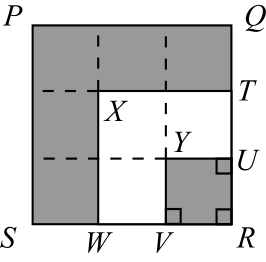
Therefore, the ratio of the shaded area to the unshaded area is , which equals .
Solution 2
Consider quadrilateral .
has three right angles: at and because and are perpendicular to and , respectively, and at because is a square. Since has three right angles, then it has four right angles and so is a rectangle.
Since , then is actually a square and has side length 1, and so has area , or 1.
Similarly, is a square of side length 2, and so has area , or 4.
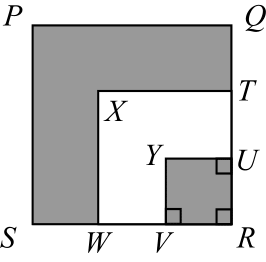
Since square is , then its area is , or 9.
The area of the unshaded region is equal to the difference between the areas of square and square , or .
Since square has area 9 and the area of the unshaded region is 3, then the area of the shaded region is .
Finally, the ratio of the shaded area to the unshaded area is , which equals .