Maths Olympiad Prep

Library / CEMC Cayley /345 of 470

CEMC Cayley, 2021

Geometry Difficulty 2.4 Junior Find the answer Canada

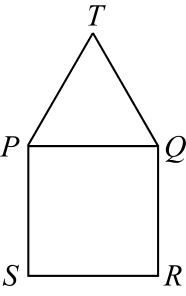
In the diagram, pentagon TPSRQTPSRQ is constructed from equilateral △PTQ\triangle PTQ and square PQRSPQRS.

Figure 0

The measure of ∠STR\angle STR is equal to

Pick one

Solution

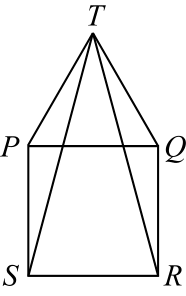
Join SS to TT and RR to TT.

Figure 1

Since PQRSPQRS is a square, ∠SPQ=90∘\angle SPQ = 90^\circ.

Since △PTQ\triangle PTQ is equilateral, ∠TPQ=60∘\angle TPQ = 60^\circ.

Therefore, ∠SPT=∠SPQ+∠TPQ=90∘+60∘\angle SPT = \angle SPQ + \angle TPQ = 90^\circ + 60^\circ.

Since PQRSPQRS is a square, SP=PQSP= PQ.

Since △PTQ\triangle PTQ is equilateral, TP=PQTP = PQ.

Since SP=PQSP = PQ and TP=PQTP = PQ, then SP=TPSP = TP which means that △SPT\triangle SPT is isosceles.

Thus, ∠PTS=12(180∘−∠SPT)=12(180∘−150∘)=15∘\angle PTS = \frac{1}{2}(180^\circ - \angle SPT) = \frac{1}{2}(180^\circ - 150^\circ) = 15^\circ.

Using a similar argument, we can show that ∠QTR=15∘\angle QTR = 15^\circ.

This means that ∠STR=∠PTQ−∠PTS−∠QTR=60∘−15∘−15∘=30∘\angle STR = \angle PTQ - \angle PTS - \angle QTR = 60^\circ - 15^\circ - 15^\circ = 30^\circ.

Want a route through all this instead of an archive? The track puts 2,604 problems in a working order, from Junior Challenge level to the IMO shortlist.

Source: CEMC, University of Waterloo, licensed CC-BY-NC-4.0. Statement reproduced verbatim; metadata (topic, difficulty) added by this project.