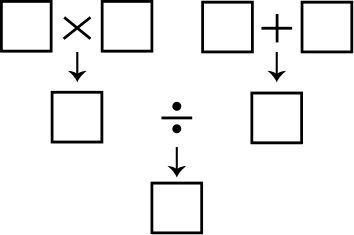
We begin by naming the boxes as shown.
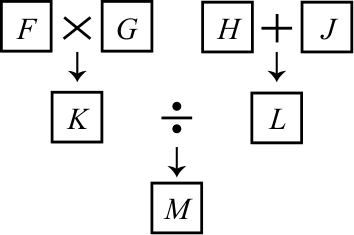
Of the five answers given, the integer which cannot appear in box M is 20. Why?
Since boxes F and G contain different integers, the maximum value that can appear in box K is 8×9=72.
Since boxes H and J contain different integers, the minimum value that can appear in box L is 1+2=3.
Next, we consider the possibilities if 20 is to appear in box M.
If 3 appears in box L (the minimum possible value for this box), then box K must contain 60, since 60÷3=20.
However, there are no two integers from 1 to 9 whose product is 60 and so there are no possible integers which could be placed in boxes F and G so that the product in box K is 60.
If any integer greater than or equal to 4 appears in box L, then box K must contain at least 4×20=80.
However, the maximum value that can appear in box K is 72.
Therefore, there are no possible integers from 1 to 9 which can be placed in boxes F,G,H, and J so that 20 appears in box M.
The diagrams below demonstrate how each of the other four answers can appear in box M.