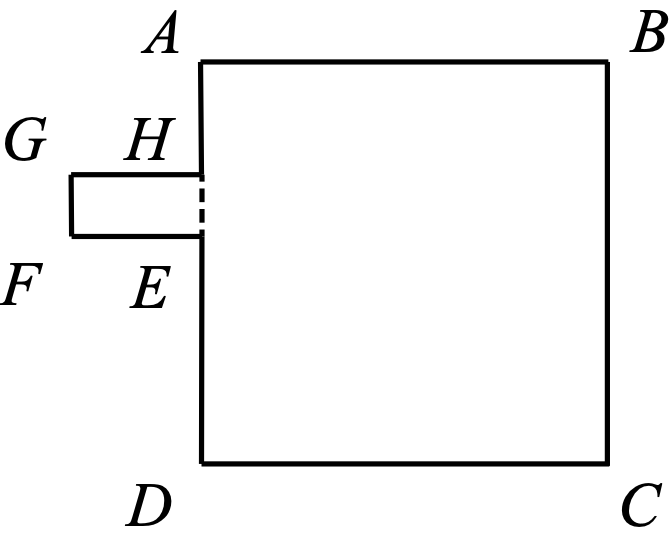
Since ABCD is a square and
its side lengths are integers, then its area is equal to a perfect
square.
Since the product of the areas of ABCD and EFGH (the rectangle) is equal to 98, then
the area of ABCD is a divisor of
98.
The positive divisors of 98 are 1, 2, 7, 14, 49, and 98.
There are exactly two divisors of 98 that are perfect squares, namely 1
and 49.
Since the area of ABCD is greater
than the area of EFGH, then the
area of ABCD is 49, and so the area
of EFGH is 2 (since 49×2=98).
Square ABCD has area 49, and so
AB=BC=CD=DA=7.
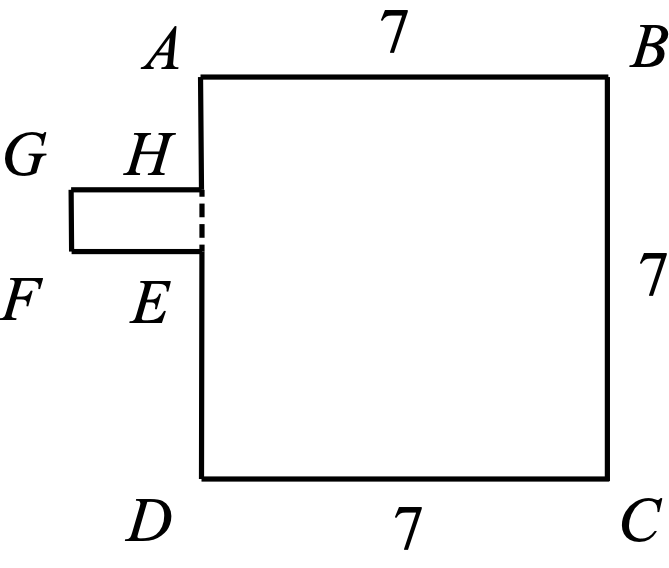
The perimeter of ABCDEFGH is
equal to =====amp;AB+BC+CD+DE+EF+FG+GH+HAamp;7+7+7+DE+EF+EH+GH+HAamp;21+DE+EH+HA+EF+GHamp;21+DA+EF+GHamp;21+7+EF+GHamp;28+2×GHamp;amp;(since EH=FG)amp;(reorganizing)amp;(since DE+EH+HA=DA)amp;(since DA=7)amp;(since EF=GH)
Since the side lengths are integers and the area of EFGH is 2, then either GH=1 (and FG=2), or GH=2 (and FG=1).
If GH=1, then the perimeter of
ABCDEFGH is 28+2×1=30.
Since 30 is not given as a possible answer, then GH=2 and the perimeter is 28+2×2=32.