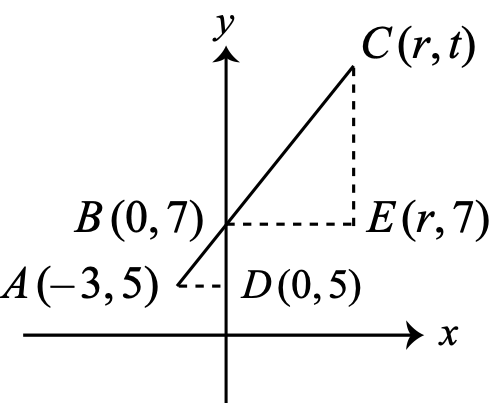
Points A(−3,5), B(0,7) and C(r,t) lie along a line. If BC=4AB and r>0, what is the value of r+t?
A number or a short expression. Fractions can be typed as 3/2, and spacing doesn't matter.
Solution
Solution 1:
Plot the points A, B, and C as well as D(0,5) and E(r,7) so that △ABD and △BCE have right angles at D and E, respectively.
These two right-angled triangles each have a horizontal side and a vertical side, as shown.
Since A, B, and C are all on the same line, AD is parallel to BE, and BD is parallel to CE, we must have that ∠DAB=∠EBC and ∠DBA=∠ECB.
Hence, △ABD is similar to △BCE.
Using common ratios, we get ABBC=DBEC=ADBE.
Each of EC and DB is vertical, so their lengths are the difference between the y-coordinates of the two points.
Thus, EC=t−7 and DB=7−5=2.
Similarly, the lengths of BE and AD are each the different between the x-coordinates of the two points, giving BE=r and AD=3.
It is given that BC=4AB, so ABBC=4. Therefore, 4=DBEC=2t−7 and 4=ADBE=3r.
Rearranging these two equations gives 8=t−7 or t=15 and 12=r, so r+t=27.
Solution 2:
Using the distance formula, AB=(7−5)2+(0−(−3))2=4+9=13 and BC=(t−7)2+(r−0)2=(t−7)2+r2 It is given that BC=4AB, so 413=(t−7)2+r2. Squaring both sides gives 16×13=(t−7)2+r2.
It is also given that A, B, and C are on a common line. This implies that the slope of the segment AB is the same as the slope of the segment BC.
These slopes are 0−(−3)7−5=32 and r−0t−7=rt−7, respectively.
Setting the computed slopes equal, we have rt−7=32, or t−7=32r.
Substituting into 16×13=(t−7)2+r2, we get the following equivalent equations. 16×1316×1316×1316×916912amp;=(32r)2+r2amp;=94r2+r2amp;=913r2amp;=r2amp;=r2amp;=r where the final equality is because r is assumed to be positive.
Therefore, we have r=12, from which we get t−7=32×12=8, or t=15.
The answer to the question is r+t=12+15=27.
Want a route through all this instead of an archive? The track
puts 2,604 problems in a working order, from Junior Challenge level to the IMO shortlist.