Maths Olympiad Prep

Library / /66 of 120

, 2012

Geometry Difficulty 5.4 AIME, harder Prove it Saudi Arabia

Let ABCABC be a triangle right-angled at AA. A circle passing through BB and CC intersects the sides ABAB and ACAC at MM, respectively NN. Prove that if BMCNBC=MN3BM \cdot CN \cdot BC = MN^3, then the symmetric point of AA with respect to the midpoint of the segment MNMN belongs to BCBC.

Solutions — 2

Solution 1

Let BC=aBC = a, CA=bCA = b, AB=cAB = c, AM=xAM = x.

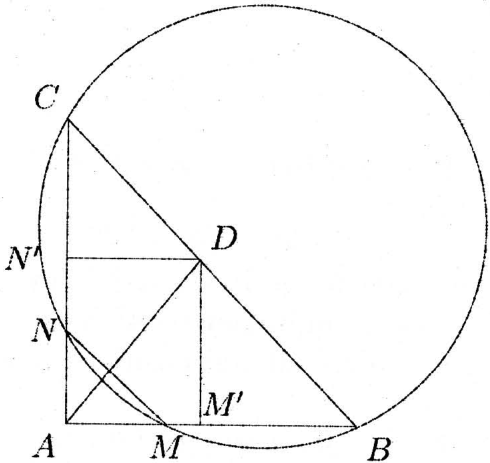
Figure 1

Triangles AMNAMN and ACBACB are similar, so
xb=ANc=MNa. \frac{x}{b} = \frac{AN}{c} = \frac{MN}{a}.
We obtain
AN=cxb,MN=axb.(1) AN = \frac{cx}{b}, \quad MN = \frac{ax}{b}. \qquad (1)
The relation BMCNBC=MN3BM \cdot CN \cdot BC = MN^3 is equivalent to
a(cx)(bcxb)=a3x3b3, a(c-x)\left(b-\frac{cx}{b}\right) = \frac{a^3x^3}{b^3},
and hence we get
a2x3b2cx2+b2(b2+c2)xcb4=0.(2) a^2x^3 - b^2cx^2 + b^2(b^2 + c^2)x - cb^4 = 0. \qquad (2)
Since b2+c2=a2b^2 + c^2 = a^2, it follows that
a2x3b2cx2+a2b2xcb4=0.(3) a^2x^3 - b^2cx^2 + a^2b^2x - cb^4 = 0. \qquad (3)
The relation (3) is equivalent to
(a2xb2c)x2+b2(a2xb2c)=0, (a^2x - b^2c)x^2 + b^2(a^2x - b^2c) = 0,
so we get
(a2xb2c)(x2+b2)=0.(4) (a^2x - b^2c)(x^2 + b^2) = 0. \qquad (4)
From (4) it follows
x=b2ca2(5) x = \frac{b^2c}{a^2} \qquad (5)
Draw ADBCAD \perp BC, DMABDM' \perp AB, DNACDN' \perp AC, where DBCD \in BC, MABM' \in AB, NACN' \in AC. We have AD2=AMABAD^2 = AM' \cdot AB, so
AM=AD2AB=b2c2a2c=b2ca2=x=AM. AM' = \frac{AD^2}{AB} = \frac{b^2c^2}{a^2c} = \frac{b^2c}{a^2} = x = AM.
This implies M=MM = M'. Also, from AD2=ANACAD^2 = AN' \cdot AC, we get
AN=AD2AC=b2c2a2b=bc2a2=cxb=AN, hence N=N. AN' = \frac{AD^2}{AC} = \frac{b^2c^2}{a^2b} = \frac{bc^2}{a^2} = \frac{cx}{b} = AN, \text{ hence } N = N'.
Therefore AMDNAMDN is a rectangle. It follows that the symmetric point of AA with respect to the midpoint of segment MNMN is DD, which completes the proof.

Solution 2

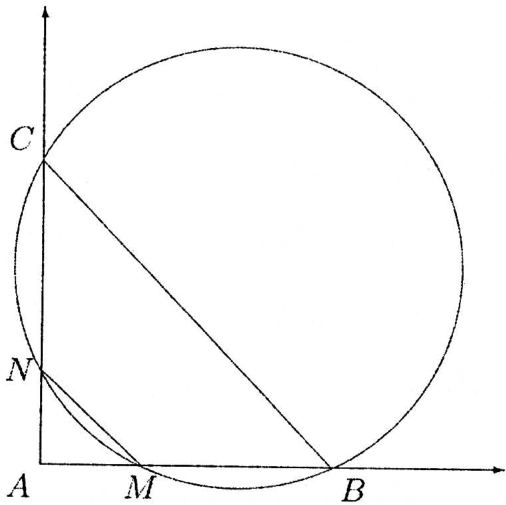
Consider the coordinates system with the origin at AA and ABAB and ACAC are the coordinate axes. We have A(0,0)A(0, 0), B(b,0)B(b, 0), C(0,c)C(0, c), M(m,0)M(m, 0), N(0,n)N(0, n).

Figure 2

The relation BMCNBC=MN3BM \cdot CN \cdot BC = MN^3 is equivalent to
(bm)(cn)b2+c2=(m2+n2)3(1) (b-m)(c-n)\sqrt{b^2+c^2} = (\sqrt{m^2+n^2})^3 \quad (1)
The quadrilateral CNMBCNMB is cyclic. Hence, from the power of AA with respect to its circumcircle we get nc=mbnc = mb. That is, n=bcmn = \frac{b}{c}m. Replacing in (1) we get
(bm)(cbcm)b2+c2=(m2(1+b2c2))3(2) (b-m) \left(c - \frac{b}{c}m\right) \sqrt{b^2+c^2} = \left(\sqrt{m^2\left(1+\frac{b^2}{c^2}\right)}\right)^3 \quad (2)
But the relation (2) is equivalent to
(bm)(cbcm)a=a3c3m3.(3) (b-m) \left(c - \frac{b}{c}m\right) a = \frac{a^3}{c^3}m^3. \quad (3)
Hence
(m2+c2)(a2mbc2)=0, (m^2 + c^2)(a^2m - bc^2) = 0,
which gives m=bc2a2m = \frac{bc^2}{a^2}. The symmetric point A1A_1 of AA with respect to the midpoint of segment MNMN has the coordinates (m,n)(m, n). But A1BCA_1 \in BC if and only if mb+nc=1\frac{m}{b} + \frac{n}{c} = 1, which is equivalent to mc+nb=bcmc + nb = bc. The last relation is equivalent to
mc+b2cm=bc, and hence m=bc2b2+c2=bc2a2, mc + \frac{b^2}{c}m = bc, \text{ and hence } m = \frac{bc^2}{b^2 + c^2} = \frac{bc^2}{a^2},
which is already proved.

Want a route through all this instead of an archive? The track puts 2,000 problems in a working order, from AMC 10 level to the IMO shortlist.

Source: MathNet, licensed CC-BY-4.0. Statement and solution reproduced as published; topic and difficulty added by this site.