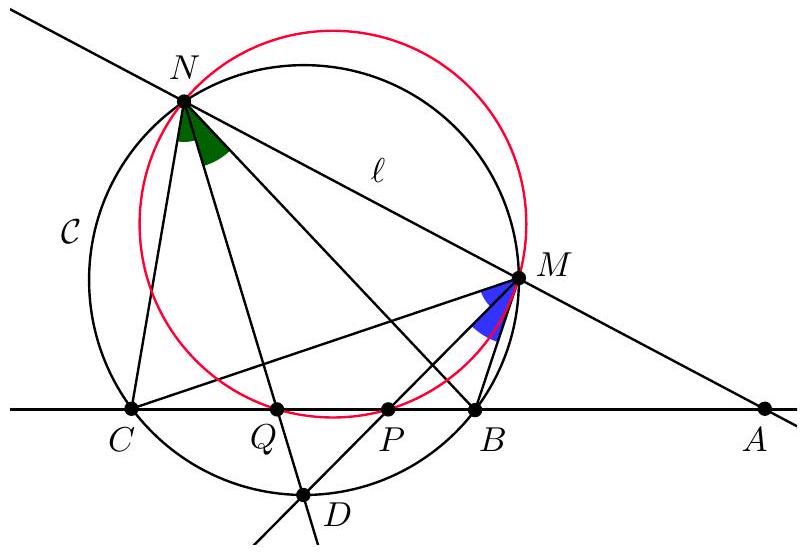
Let A, B, C be colinear points in this order, C an arbitrary circle passing through B and C, and l an arbitrary line different from BC, passing through A and intersecting C at M and N. The bisectors of the angles ∠CMB and ∠CNB intersect BC at P and Q. Prove that AP⋅AQ=AB⋅AC.
Solution
Let D be the midpoint of the arc BC of the circle C opposite to both M, N. Because CD = DB, the bisectors of angles ∠CMB and ∠CNB, both, intersect the arc CB at D.
Therefore, we have N Q C = 1 2 ( NC + DB ) = 1 2 ( NC + CD ) = 1 2 ND = N M P. This proves that quadrilateral MNQP is cyclic. But quadrilateral MNCB is also cyclic and lines MN, BC intersect at A, hence by the power of the point A with respect to these two circles we have AP⋅AQ=AM⋅AN=AB⋅AC.
Want a route through all this instead of an archive? The track
puts 2,604 problems in a working order, from Junior Challenge level to the IMO shortlist.
Source: MathNet,
licensed CC-BY-4.0.
Statement reproduced verbatim; metadata (topic, difficulty) added by this project.