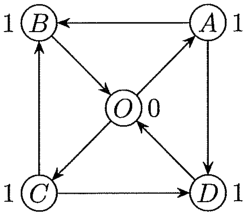
The JMO Cluster initially consists of five stars , , , , and . Each star is assigned a value called its importance. The importance of is , and the importance of each of , , , and is . Moreover, there are one-way direct flights from to and ; from to and ; from to ; from to and ; and from to , and no other direct flights exist.
To prevent the stars from aging, the JMO Cluster periodically performs an operation consisting of the following sequence of actions:
(1) Abolish all existing direct flights and destroy all the stars.
(2) For each direct flight abolished in step (1), construct a new star . Then assign to an importance equal to the sum of the importances of the departure and arrival stars of .
(3) For every ordered pair of two abolished direct flights such that the arrival star of coincides with the departure star of , open a one-way direct flight from to .
Find the sum of the importances of the stars constructed in the 100th operation.
Japanese Mathematical Olympiad
Solution
Let the initial configuration be called state , and for each integer , let state denote the configuration after the -th operation.
Lemma 1. There exists an assignment of every star into exactly one of groups , , or such that:
(1) Star is assigned to group .
(2) For every flight , the star belongs to the same group as the arrival star of .
(3) For every flight , if the departure star of lies in group , then its arrival star lies in group (where group is identified with group ).
Proof of Lemma 1. In state , assign the five stars , , , , to groups , , , , , respectively. Now assume inductively that every star in states , , ..., has already been assigned to a group satisfying conditions (1)-(3). To extend the assignment to state , proceed as follows:
* For each flight in state , assign the new star to the same group as the arrival star of . This guarantees condition (2) in the new state.
* To check condition (3), consider any flight that appears in state . By construction this means the arrival star of coincides with the departure star of . If lies in group , then its arrival star is in group , so by the induction hypothesis the arrival star of (hence ) must lie in group .
This completes the inductive step, and hence the proof. ■
Using Lemma 1, partition all stars into the three groups. For any star , we define such that belongs to group . Moreover, we set , , . For any integer , define , where is the remainder when is divided by .
Lemma 2. For any star , the number of outgoing flights from is .
Proof of Lemma 2. We argue by induction on , where is a star in state . The base holds by inspection. Assume the claim for state , and let be any flight in state , arriving at some star . Then the number of flights departing from in state equals , which is the number of flights departing from in state . Since , this completes the induction. ■
Lemma 3. For each nonnegative integer and each integer , all stars in state that lie in group have the same importance, say .
Proof of Lemma 3. We proceed by induction on . The claim is clear for . Suppose it holds for . Let be any flight in state , departing from a star and arriving at a star . Then we have
From Lemma 3 we have the recurrence . Let . Then, we have with , so . Moreover, it follows that
and therefore
Thus, we have
Next, let be the number of stars in state lying in group . Since each new star in state corresponds to a flight departing from a star in group , Lemma 2 yields
In particular one finds
With , , this gives
Finally, the total importance in state is