lines are drawn in the plane, and all the intersection points of these lines are marked. It is appeared that one of lines contains exactly 1 marked point, one of lines contains exactly 3 marked points, and one of lines contains exactly 5 marked points. Find all the possible values of . (I. Bogdanov)
Russian Mathematical Olympiad
Solution
Answer: lines.
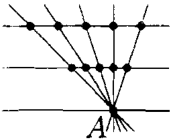
Fig. 14
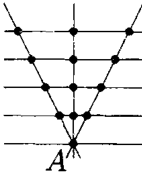
Fig. 15
Let , , be the lines on which , , and points are marked, respectively, and let be the only marked point on . Then all other lines either pass through this point (call these lines meridians) or are parallel to (call these parallels). Note that each meridian intersects each parallel, and all such intersection points are distinct; moreover, these points exhaust all intersection points except . Thus, each meridian has the same number of marked points, and each parallel as well. From the condition, it follows that either each meridian has points and each parallel has (so there are parallels and meridians, see Fig. 14), or vice versa (so there are parallels and meridians, see Fig. 15). In both cases, there are lines.
Want a route through all this instead of an archive? The track
puts 2,604 problems in a working order, from Junior Challenge level to the IMO shortlist.