Let be a parallelogram. The circle through and intersects the lines , , and in points , , and respectively. Let be the intersection point of the lines and . Prove that is equidistant from the lines and .
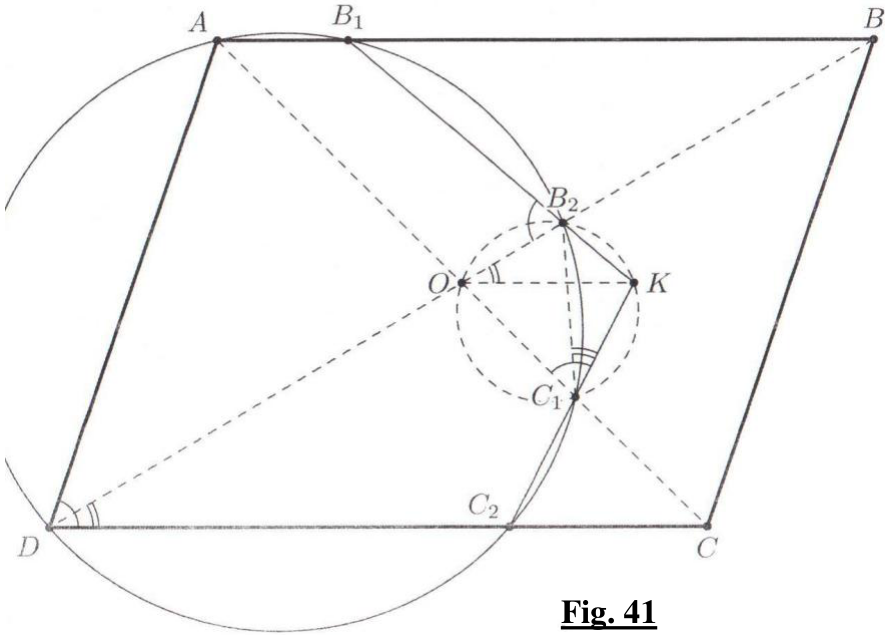
Fig. 41
Let be a parallelogram. The circle through and intersects the lines , , and in points , , and respectively. Let be the intersection point of the lines and . Prove that is equidistant from the lines and .
Fig. 41
Let be the intersection point of the diagonals of the parallelogram. Let's prove that the points , , and lie on the same circle. In fact, with the cyclicity of points , , , , and and parallelism of and we have (Fig. 41):
Now , thus . As known, diagonals and are divided by a point in half. By the Thales' theorem the line (and accordingly, the point ) is equidistant from the lines and .