Progetto Olimpiadi di Matematica - GARA di SECONDO LIVELLO
GeometryDifficulty 4.6AIMEFind the answerItaly
Problem:
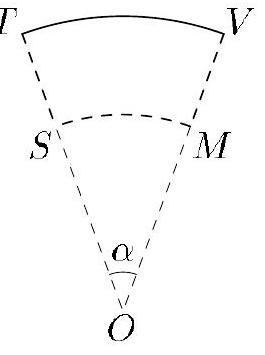
A river is crossed by two bridges TS and VM; the two banks TV and SM are two arcs of concentric circles; the two bridges TS and VM are aligned with the center (see the figure). A person wants to get to V starting from T by choosing the shortest path between the two possible ones:
(1) following the river along the arc of circle TV
(2) crossing the bridge TS, following the river along the other bank (SM) and crossing the bridge MV.
We denote by α the angle subtended by the two arcs of circle, by R the length of OT and by r the length of OS. Which data must the person necessarily have information about in order to make the best choice?
Pick one
Solution
Solution:
The answer is (C). Measuring the angle α in radians, the length of the first path is Rα, while the length of the second is 2(R−r)+rα. Therefore the first path is the shorter one if and only if Rα<2(R−r)+rα, that is if and only if (R−r)(α−2)<0. Since R−r>0 the choice depends only on α.
Want a route through all this instead of an archive? The track
puts 2,604 problems in a working order, from Junior Challenge level to the IMO shortlist.
Source: MathNet,
licensed CC-BY-4.0.
Statement translated into English from it; metadata (topic, difficulty) added by this project.