Let be the foot of perpendicular from to the Euler line (the line passing through the circumcentre and the orthocentre) of an acute scalene triangle . A circle with centre passes through and , and it intersects sides and at and respectively. Let be the foot of altitude from to , and let be the midpoint of . Prove that the circumcentre of triangle is equidistant from and .
IMO Shortlist, 2016
Solutions — 2
Solution 1
Let the perpendicular from to meet line at . Let be the foot of altitude from to side . Since and lie on the perpendicular bisector of , using directed angles, we have
This shows are concyclic.
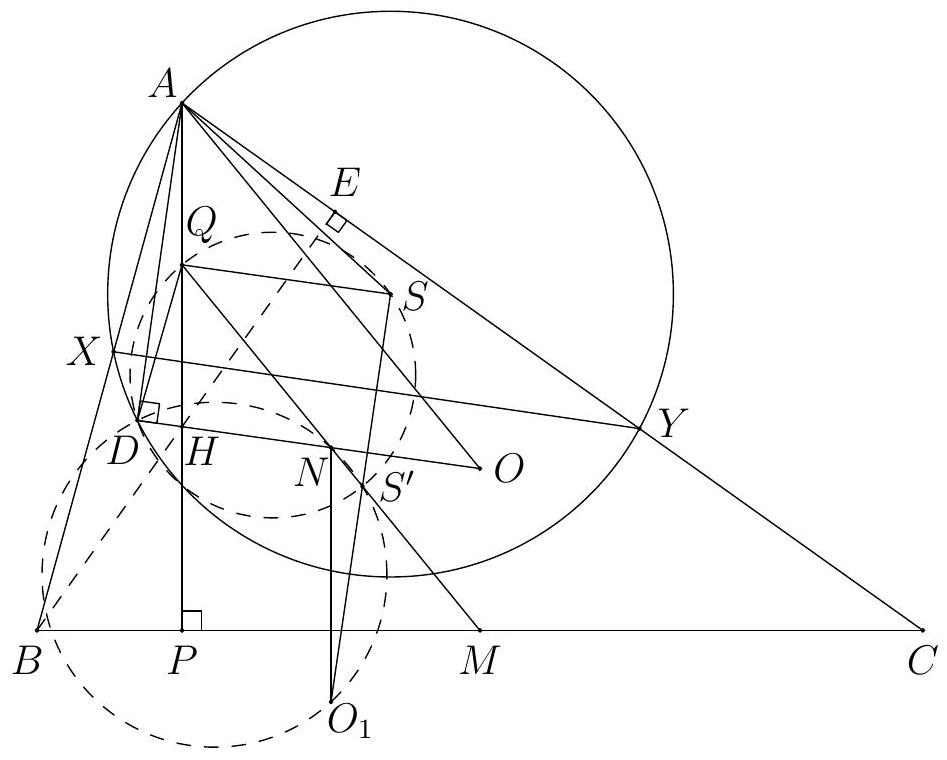
Let the perpendicular from to intersect line at . (Note that the two lines coincide when is the midpoint of , in which case the result is true since the circumcentre of triangle must lie on this line.) It suffices to show that is the circumcentre of triangle since lies on the perpendicular bisector of . From
since and , we know that are concyclic. Therefore, we get
so that is a tangent to the circle through . Then we have
Next, we show that and are symmetric with respect to . By the Sine Law, we have
It follows that
which is twice the distance from to . Note that and lie on the same side of the perpendicular bisector of if and only if if and only if . This shows and lie on different sides of . As lies on ray , it follows that and cannot lie on the same side of . Therefore, and are symmetric with respect to .
Let be the diameter of the circumcircle of triangle . As is twice the distance from to and , we have . It follows from (1) that . As is the perpendicular bisector of , point is the circumcentre of triangle .
Solution 2
Denote the orthocentre and circumcentre of triangle by and respectively. Let be the circumcentre of triangle . Consider two other possible positions of . We name them and and define the analogous points accordingly. Note that lie on the perpendicular bisector of .
As and meet at and the circumcircles of triangles and meet at , there is a spiral similarity with centre mapping to . We find that
and similarly . This shows triangles and are directly similar. Then the spiral similarity with centre takes points to . Similarly, there is a spiral similarity with centre mapping to . From these, we see that there is a spiral similarity taking the corresponding points to points . In particular, are collinear.
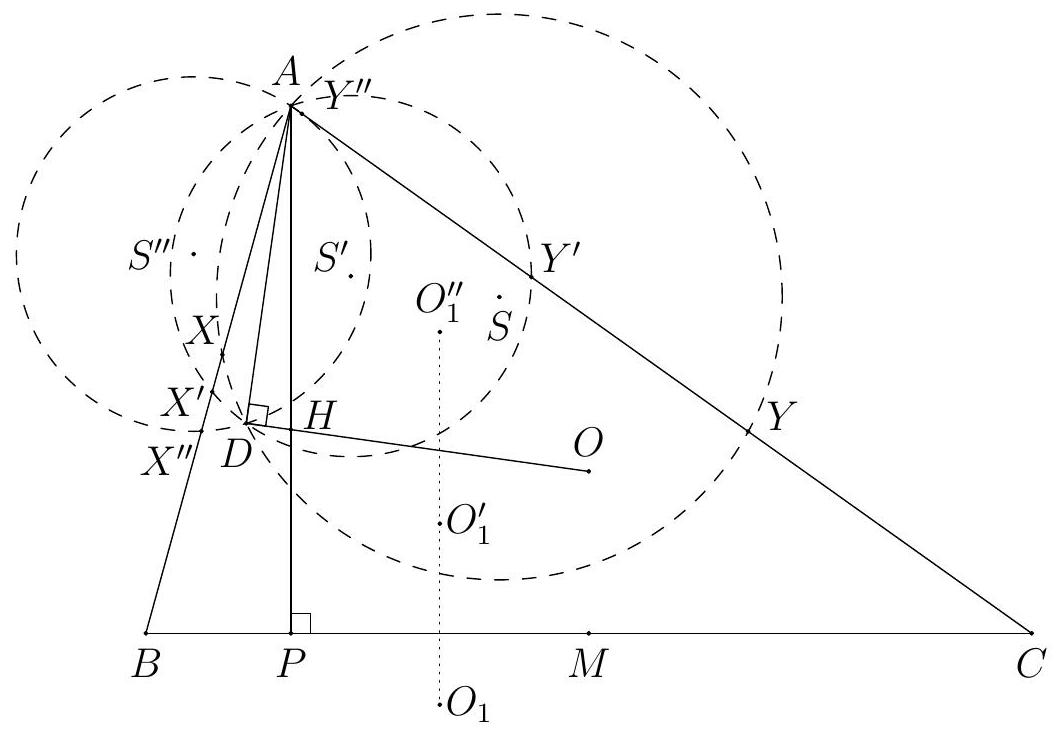
It now suffices to show that lies on the perpendicular bisector of for two special cases.
Firstly, we take to be the midpoint of . Then and are the feet of altitudes from and respectively. It is well-known that the circumcircle of triangle is the nine-point circle of triangle . Then is the nine-point centre and . Indeed, and also lies on the nine-point circle.
Secondly, we take to be the midpoint of . Then and are the midpoints of and respectively. Then . Clearly, lies on the perpendicular bisector of . This shows the perpendicular bisectors of and coincide. Hence, we must have .
Want a route through all this instead of an archive? The track
puts 2,604 problems in a working order, from Junior Challenge level to the IMO shortlist.