The answer is the following:
* If gcd(m,n)>1, then Freyja cannot win.
* If gcd(m,n)=1, then Freyja can win in a minimum of (m−1)2+(n−1)2 questions.
First, we dispose of the case where gcd(m,n)>1. Write d=gcd(m,n). The idea is that any labeling where each 1×d rectangle has sum zero is valid. Thus, to learn the labeling, Freyja must ask at least one question in every row, which is clearly not possible in a finite number of questions.
Now suppose gcd(m,n)=1. We split the proof into two halves.
¶ Lower bound
Clearly, any labeling where each m×1 and 1×m rectangle has sum zero is valid. These labelings form a vector space with dimension (m−1)2, by inspection. (Set the values in an (m−1)×(m−1) square arbitrarily and every other value is uniquely determined.)
Similarly, labelings where each n×1 and 1×n rectangle have sum zero are also valid, and have dimension (n−1)2.
It is also easy to see that no labeling other than the all-zero labeling belongs to both categories; labelings in the first space are periodic in both directions with period m, while labelings in the second space are periodic in both directions with period n; and hence any labeling in both categories must be constant, ergo all-zero.
Taking sums of these labelings gives a space of valid labelings of dimension (m−1)2+(n−1)2. Thus, Freyja needs at least (m−1)2+(n−1)2 questions to win.
¶ Proof of upper bound using generating functions, by Ankan Bhattacharya
We prove:
Claim (Periodicity) — Any valid labeling is doubly periodic with period mn.
Proof. By Chicken McNugget, there exists N such that N and N+1 are both nonnegative integer linear combinations of m and n.
Then both mn×N and mn×(N+1) rectangles have zero sum, so mn×1 rectangles have zero sum. This implies that any two cells with a vertical displacement of mn are equal; similarly for horizontal displacements. □
With that in mind, consider a valid labeling. It naturally corresponds to a generating function
f(x,y)=a=0∑mn−1b=0∑mn−1ca,bxayb
where ca,b is the number in (a,b).
The generating function corresponding to sums over n×m rectangles is
f(x,y)(1+x+⋯+xm−1)(1+y+⋯+yn−1)=f(x,y)⋅x−1xm−1⋅y−1yn−1.
Similarly, the one for m×n rectangles is
f(x,y)⋅x−1xn−1⋅y−1ym−1.
Thus, the constraints for f to be valid are equivalent to
f(x,y)⋅x−1xm−1⋅y−1yn−1andf(x,y)⋅x−1xn−1⋅y−1ym−1
being zero when reduced modulo xmn−1 and ymn−1, or, letting ω=exp(2πi/m), both terms being zero when powers of ω are plugged in.
To restate the constraints one final time, we need
f(ωa,ωb)⋅ωa−1ωam−1⋅ωb−1ωbn−1=f(ωa,ωb)⋅ωa−1ωan−1⋅ωb−1ωbm−1=0
for all a,b∈{0,…,mn−1}.
This implies f(ωa,ωb)=0 for most choices of (a,b). If it does not, we need
ωa−1ωam−1⋅ωb−1ωbn−1=ωa−1ωan−1⋅ωb−1ωbm−1=0.
This happens when (at least) one fraction in either product is zero.
* If the first fraction is zero, then either n∣a and a>0, or m∣b and b>0.
* If the second fraction is zero, then either m∣a and a>0, or n∣b and b>0.
If the first condition holds in both cases, then mn∣a, but 0<a<mn, a contradiction. Thus if n∣a, then we must have n∣b, and similarly if m∣a then m∣b.
The former case happens (m−1)2 times, and the latter case happens (n−1)2 times. Thus, at most (m−1)2+(n−1)2 values of f(ωa,ωb) are nonzero. It follows that the dimension of the space of valid labelings is at most (m−1)2+(n−1)2, as desired.
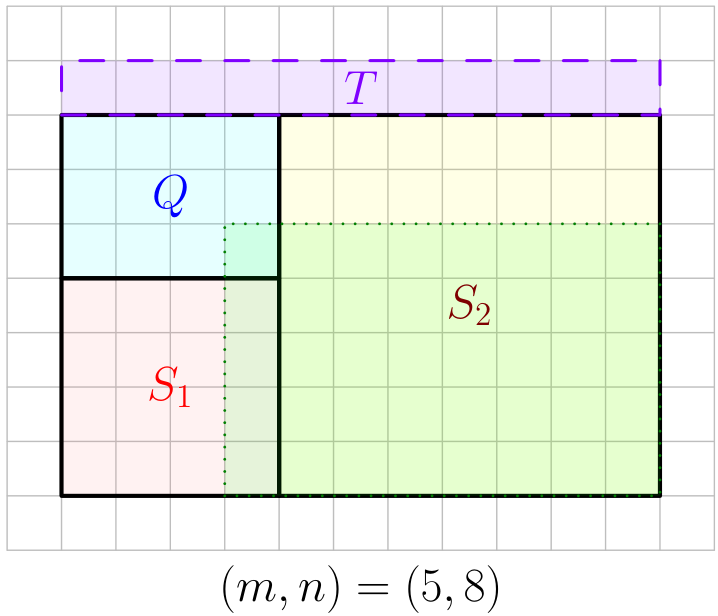
Let Freyja ask about all cells (x,y) in the two squares
S1S2=[1,m−1]×[1,m−1]=[m,m+n−2]×[1,n−1].
In the beginning, one by one, Freyja determines all values inside of the rectangle Q:=[1,m−1]×[m,n−1]. To that end, on each step she considers some rectangle with m rows and n columns such that its top left corner is in Q and all of the other values in it have been determined already. In this way, Freyja uncovers all of Q, starting with its lower right corner and then proceeding upwards and to the left.
Thus Freyja can learn all numbers inside of the rectangle
R:=[1,m+n−2]×[1,n−1]=Q∪S1∪S2.
See the figure below for an illustration for (m,n)=(5,8). The first cell of Q is uncovered using the dotted green rectangle.
We need one lemma:
Lemma
Let m and n be positive integers with gcd(m,n)=1. Consider an unknown sequence of real numbers z1,z2,…,zs with s≥m+n−2. Suppose that we know the sums of all contiguous blocks of size either m or n in this sequence. Then we can determine all individual entries in the sequence as well.
Proof. By induction on m+n. Suppose, without loss of generality, that m≤n. Our base case is m=1, which is clear. For the induction step, set ℓ=n−m. Each contiguous block of size ℓ within z1,z2,…,zs−n is the difference of two contiguous blocks of sizes m and n within the original sequence. By the induction hypothesis for ℓ and m, it follows that we can determine all of z1,z2,…,zs−n. Then we determine the remaining zi as well, one by one, in order from left to right, by examining on each step an appropriate contiguous block of size m. □
Let T be the rectangle [1,m+n−2]×{n}. By looking at appropriate rectangles of sizes m×n and n×m such that their top row is contained within T and all of their other rows are contained within R, Freyja can learn the sums of all contiguous blocks of values of sizes m and n within T. By the Lemma, it follows that Freyja can uncover all of T.
In this way, with the help of the Lemma, Freyja can extend her rectangular area of knowledge both upwards and downwards. Once its height reaches m+n−2, by the same method she will be able to extend it to the left and right as well. This allows Freyja to determine all values in the grid. Therefore, (m−1)2+(n−1)2 questions are indeed sufficient.