Stage 9 · Geometry
-
Let be the circumcircle of a triangle , and let be its excircle which is tangent to the segment . Let and be the intersection points of and . Let and be the projections of onto the tangent lines to at and , respectively. The tangent line at to the circumcircle of the triangle intersects the tangent line at to the circumcircle of the triangle at a point . Prove that .
IMO Shortlist 2021
-
Let be the origin in the three dimensional coordinate space. The weight of a point is the sum of the absolute values of its coordinates. A point is a primitive lattice point if all its coordinates are integers with their greatest common divisor equal to 1. A square is called a unbalanced primitive integer square if it has integer side length and the points and are primitive lattice points with different weights.
Show that there are infinitely many unbalanced primitive integer squares such that the plane containing the squares are not parallel to each other.USA IMO
-
Let be a positive integer. Consider
as a set of points in three-dimensional space. Determine the smallest possible number of planes, the union of which contains but does not include .
(This problem was suggested by the Netherlands.)International Mathematical Olympiad
-
Let be an integer. Suppose we are given points in a plane such that no three of them are collinear. The points are to be labelled in some order. We then consider the angles . We measure each angle in the way that gives the smallest positive value (i.e. between and ). Prove that there exists an ordering of the given points such that the resulting angles can be separated into two groups with the sum of one group of angles equal to the sum of the other group.
IMO Shortlist 2019
-
Let be a triangle with circumcircle , incircle , and excircle with respect to vertex . Consider to be the tangent points of with , respectively.
a. Let be the midpoint of . The circle with diameter intersects again at , respectively. Prove that the circles and meet again at a point on circle .
b. Assume that intersects at . Let be the intersections of with , respectively. Consider on respectively such that . Denote as the intersection of and as the midpoint of the major arc of . Prove that intersect at a point on the circle .
VN IMO Booklet
-
A rabbit is at some point in the Euclidean plane. There are some (possibly infinitely many) landmines, which are circles with any radius that do not intersect except possibly at one point (tangent). Every move, the rabbit can hop a distance of exactly , but cannot land in the interior of a landmine (but may possibly land on the edge). Suppose that neither the rabbit nor the origin is in a landmine. Find the minimum so that the rabbit can always reach a point with a distance of at most from the origin, regardless of the landmine configuration.
Balkan Mathematical Olympiad Shortlisted Problems
-
Given a circle with a fixed chord ( is not a diameter of the circle). Let move on the bigger arc such that is an acute triangle and . Let and respectively be the midpoint of and the orthocenter of the triangle . The ray intersects the circle again at , the line intersects the line at and the line intersects the circle again at . From , we draw a perpendicular line to , intersecting at .
a) Prove that point belongs to a fixed circle when moves along the bigger arc .
b) The circle goes through and touching at intersects , at , , respectively. Let be the midpoint of . Prove that the line always goes through a fixed point.
IMO Team Selection Tests 2015
-
In an acute triangle with , the perpendicular bisectors of sides and intersect segment at points and , respectively. The tangents to at the points and intersect and at points and , respectively. Suppose that lines and intersect at point . Define points and to be the intersections of and the lines and , respectively. Prove that the lines and are concurrent.
Baltic Way Shortlist 2023
-
Let be a triangle and be a point that differs from , and . Let be the reflection of through , and be the reflection of through . We define , , and similarly. Let be the line passing through and perpendicular to . Define , similarly.
a) Assume that is the orthocenter of triangle , show that the respective reflections of the lines , and through each bisector of angles , and are coincident.
b) Assume that is the nine-point center of triangle , show that the respective reflections of the lines , and through the lines , and concur.
TST
-
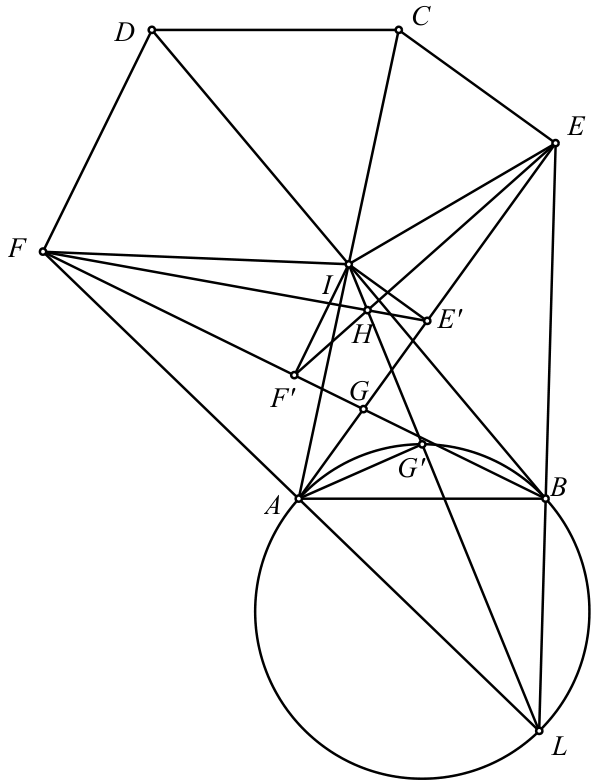
Let be a parallelogram and intersects at . Let be the point inside triangle that satisfies
Let be projections of on and on . The median respect to vertex of triangle and the median respect to vertex of triangle intersects at .a) Prove that and are concurrent, denote the concurrent point by .
b) Let be the intersection of and . Let be the circumcenter of triangle and be the circumcenters of , respectively. Prove that and the line passing through the circumcenters of are concurrent.
IMO Team Selection Test
Answer key — Stage 9 · Geometry
- Prove it — see the worked solution
- Prove it — see the worked solution
- Prove it — see the worked solution
- Prove it — see the worked solution
- Prove it — see the worked solution
- Prove it — see the worked solution
- Prove it — see the worked solution
- Prove it — see the worked solution
- Prove it — see the worked solution
- Prove it — see the worked solution